



















Motion Artifact reduction in ECG harness
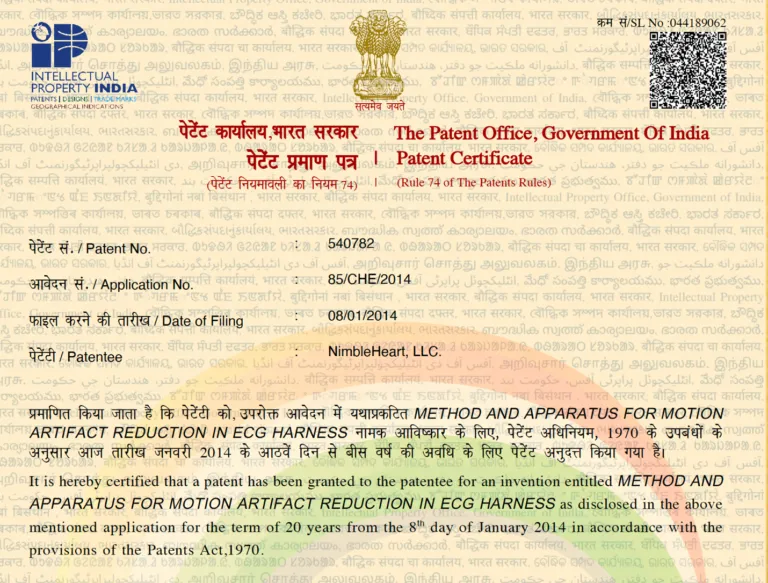
The patent is for getting a clinical grade ECG during normal movement and exercises (like in a treadmill stress test) conveniently and quickly from a dry electrode wearable ECG harness without shaving, skin preparation or applying any gels in a convenient manner outside the hospital for cardiac preventive care.
An ECG sensor harness is a desirable form of a device that can be used by the people for home based cardiac monitoring and that does not require any hook up by medical professionals. The device needs to detect anomalies including, but not limited to, myocardial infarctions (MI), ischemia and arrhythmia. The ECG harnesses that are currently available provide limited information and limited performance. One of the causes for the performance limitation of these systems may be motion artifacts.
Motion artifacts may occur when the subject is in motion during exercise or even moderate movement. Motion artifacts in the ECG signal may be realized in an impedance change seen by the sensor. A distorted signal can result in improper detection of ST segment changes in ECG. In many current solutions to detect ST segment changes, the user must remain relatively still to reduce or eliminate motion artifacts that may interfere with the performance of the system. This makes the detection of exercise-induced Ischemia difficult, if not impossible. The motion artifacts may be divided into two distinct components, those normal to the sensor-body interface and shear those tangential to the sensor-body interface. It is desirable to have a solution that either eliminates or minimizes both of these components so that clinical quality ST changes detection is possible with the obtained ECG signal.
The invention uses two types of forces to keep the dry electrodes on the patient skin during exercises. Those are normal force to push the dry electrodes towards the body and the shear force to prevent the movement of the electrodes on the body of the patients. These two forces are applied simultaneously and continuously when the patient is wearing the ECG harness during rest, simple activity and exercises. The forces are implemented using simple materials inside the ECG harness.
Some solutions attempt to reduce motion artifacts using additional normal force to push the sensors on the body. However they are not sufficient in mitigating the motion artifacts. Harnesses are designed based on dry electrodes typically and the dry electrodes can’t control shear movement of the sensors. Some dry electrodes use structures that pierce the skin’s layer stratum corneum to avoid motion artifacts and may cause discomfort after long usage on chest area. The ideal solution for a harness needs to be gentle for the body. These solutions were never commercialized and did not allow the Exercise ECG monitoring or the early detection on the population at risk.
The product using this patent is built as an exercise ECG harness with dry electrodes and is a cost effective solution due to the ease of use, convenience to apply the harness without needing significant ECG device training or expensive hospital stress test setup, reusable and clinically safe electrodes and no need of shaving the patient skin that makes it quick. This allows clinical efficiency and patient compliance to preventive care.
NimbleHeart has already built the products that received FDA 510(k) clearance in 2017. They are being used by health systems, rehab programs and first responder wellness screening service providers in the US.
Industries where the invention can be useful?
Cardiac healthcare, hospitals, occupational health, rural healthcare, remote healthcare, cardiac rehabilitationAn estimate of the total addressable market?
The cardiac rehab telemetry market in India is about $50M and the occupational wellness cardiac screening market in India is about $500MPotential Customers/End Users. Who might benefit?
Medical device designers and manufacturersDocuments
-
1778455392763_701.pdf
Actions
Added all portfolio
| Country | Current Status | Patent Application Number | Patent Number | Applicant / Current Assignee Name | Title | Google Patent Link |
| India | Granted | 85/CHE/2014 | 540782 | NimbleHeart | METHOD AND APPARATUS FOR MOTION ARTIFACT REDUCTION IN ECG HARNESS | Google patent link |
You may also like the following patent
3D Oral Imaging Tray System
| Available For: Saudi Arabia | Pharmaceuticals and Biotechnology |
This invention relates to a three-dimensional oral imaging system designed to capture accurate digital impressions of teeth, gums, and surrounding oral structures in a simple and comfortable manner....
| Application Number | 523451561 |
| Patent Number | SA 19790 |
| Current Status | Granted |
Smart Medication Gamification System
| Available For: India | Pharmaceuticals and Biotechnology |
A smart medication management system that uses connected pharmaceutical packaging and software to monitor when patients take their medication. The system records medication events, reminds patients...
| Application Number | 201717046644 |
| Patent Number | 579106 |
| Current Status | Granted |
THREE-DIMENSIONAL ORAL IMAGING SYSTEM AND METHOD
| Available For: Germany | Pharmaceuticals and Biotechnology |
This invention relates to a tray-based three-dimensional oral imaging system designed to capture accurate digital images of a patient’s teeth, gums, and lips in a single, stable scanning...
| Application Number | MARGHALANI, Thamer |
| Patent Number | |
| Current Status | Awaiting Examination |
THREE-DIMENSIONAL ORAL IMAGING SYSTEM AND METHOD
| Available For: China | Pharmaceuticals and Biotechnology |
This invention relates to a tray-based three-dimensional oral imaging system designed to capture accurate digital images of a patient’s teeth, gums, and lips in a single, stable scanning...
| Application Number | 2022800333318 |
| Patent Number | |
| Current Status | Awaiting Examination |
THREE-DIMENSIONAL ORAL IMAGING SYSTEM AND METHOD
| Available For: India | Pharmaceuticals and Biotechnology |
This invention relates to a tray-based three-dimensional oral imaging system designed to capture accurate digital images of a patient’s teeth, gums, and lips in a single, stable scanning process....
| Application Number | 202317073670 |
| Patent Number | N/A |
| Current Status | Awaiting Examination |
THREE-DIMENSIONAL ORAL IMAGING SYSTEM AND METHOD
| Available For: United States | Pharmaceuticals and Biotechnology |
This invention relates to a three-dimensional oral imaging system that captures accurate digital images of a patient’s teeth, gums, and lips using a specially designed dental tray placed inside the...
| Application Number | 17/324,980 |
| Patent Number | US11382727 |
| Current Status | Granted |
Tarpan glasses
| Available For: India | Pharmaceuticals and Biotechnology |
Tarpan Glasses are a reusable eyewear-based device designed to make the Ayurvedic eye lubrication procedure known as Tarpan easier, faster, and more comfortable. The device creates a sealed space...
| Application Number | 202021004558 |
| Patent Number | 545912 |
| Current Status | Granted |