

















Automated system for cleaning of solar photovoltaic panels in solar array and method thereof
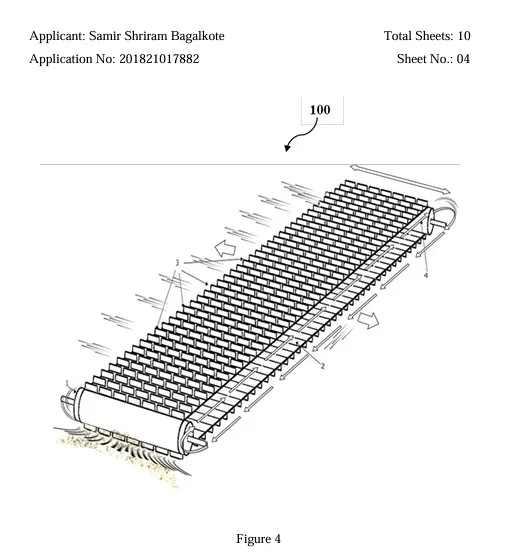
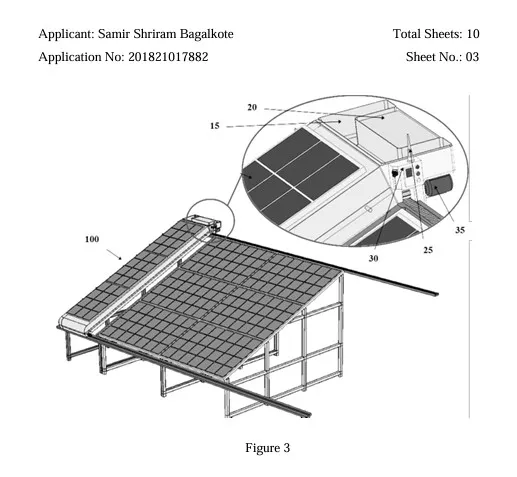
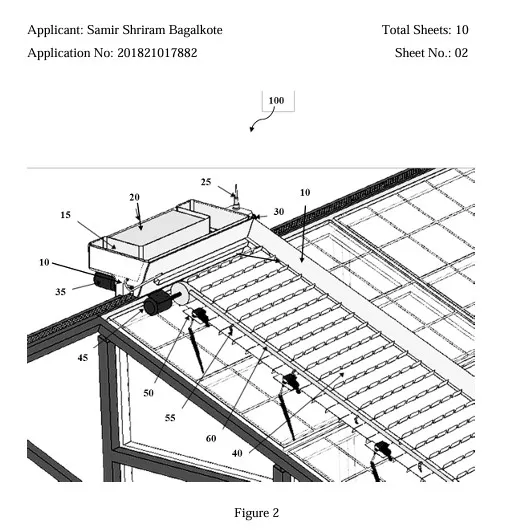
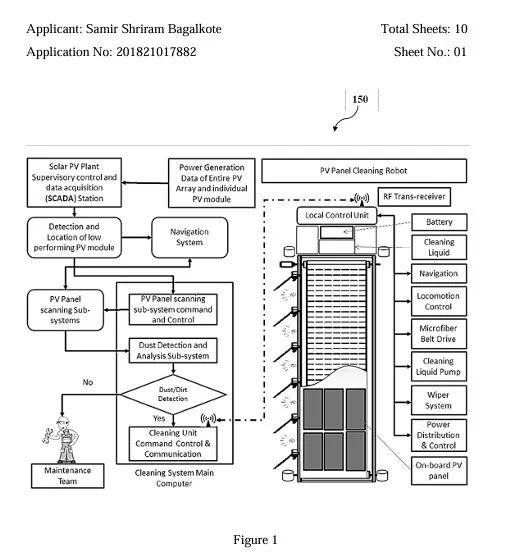
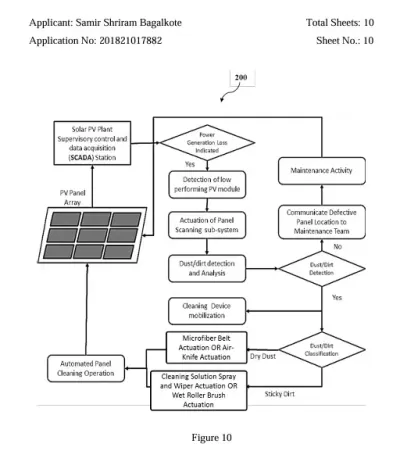
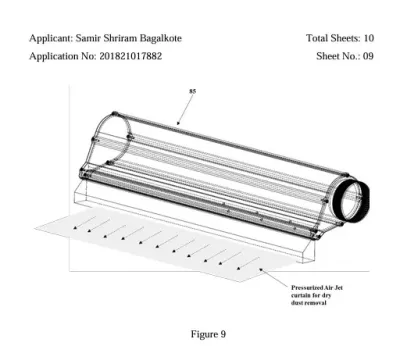
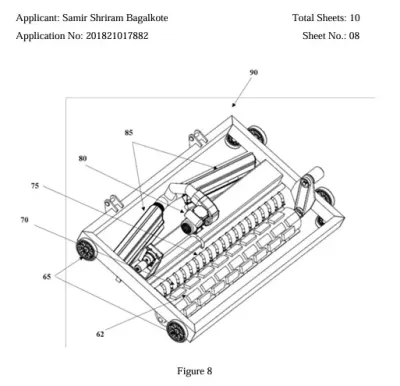
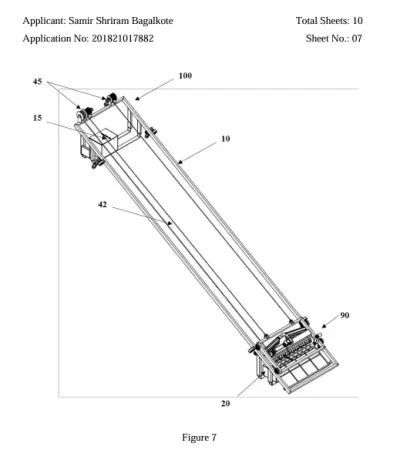
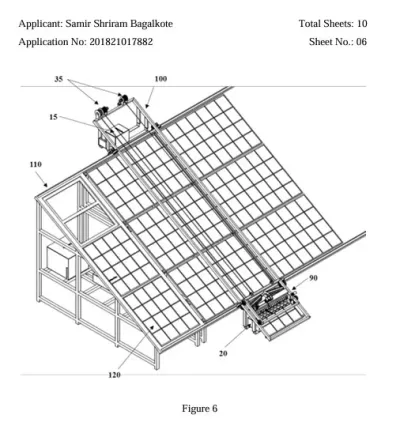
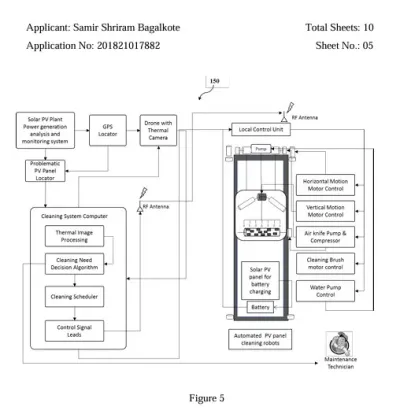
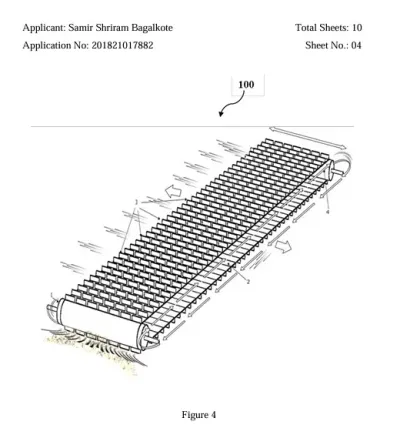
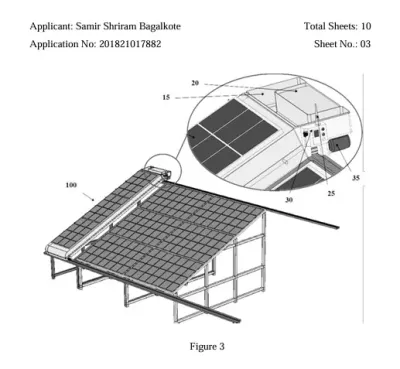
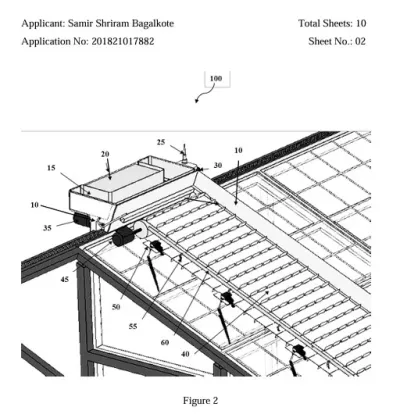
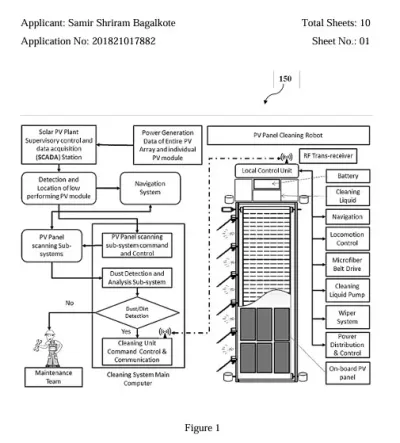
The present invention relates to an automated system for cleaning solar photovoltaic (PV) panels arranged in a continuous solar array and a method thereof. More particularly, the invention provides an intelligent, SCADA-integrated robotic cleaning system configured to automatically detect underperforming PV panels, identify their location within the solar array, assess the nature and extent of dust or dirt deposition, and selectively perform dry and/or wet cleaning operations to improve panel cleaning efficiency and maintain optimal power generation.
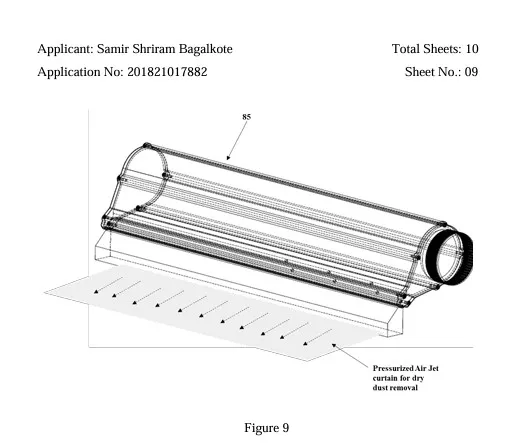
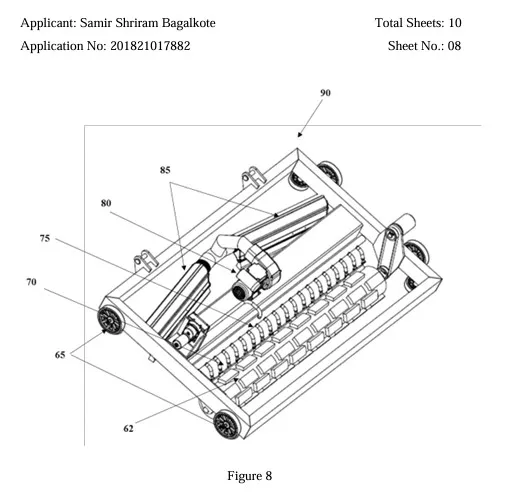
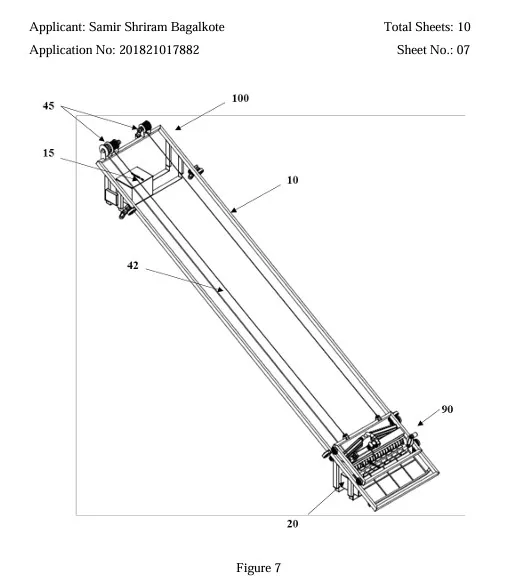
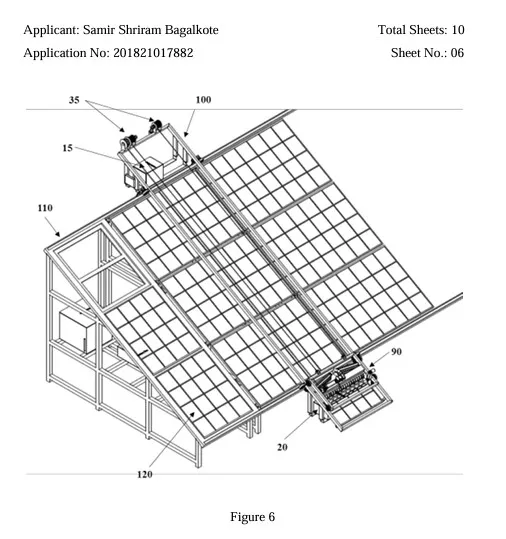
In one aspect, the invention provides an automated robotic cleaning system comprising a carriage frame, a cleaning solution and water reservoir, an onboard battery, a control unit having a wireless communication interface, a drive assembly, and a vertically mounted cleaning module operably coupled to a cleaning module drive unit. The cleaning module comprises a dry cleaning unit for removing loose dust particles and a wet cleaning unit for removing sticky dirt and other persistent contaminants from the PV panel surfaces. The drive assembly enables the robotic cleaning device to navigate along the PV panel rows, while the cleaning module drive unit facilitates transverse movement of the cleaning module across the width of the panels and synchronized movement along the length of the panel row. The robotic cleaning device is configured to be docked at a docking station positioned at one end of a PV panel row and operates in communication with the SCADA station of the solar array.
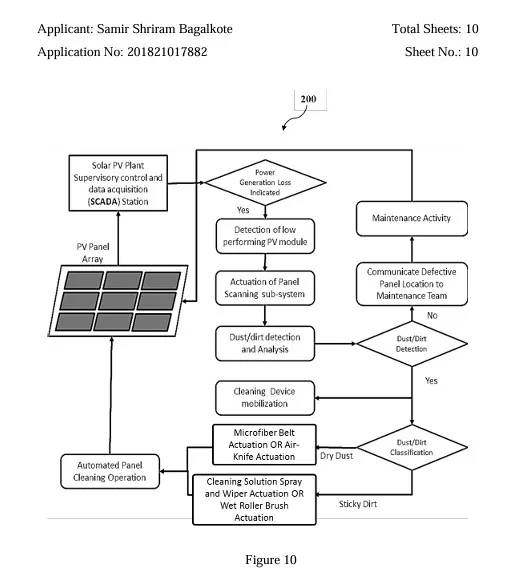
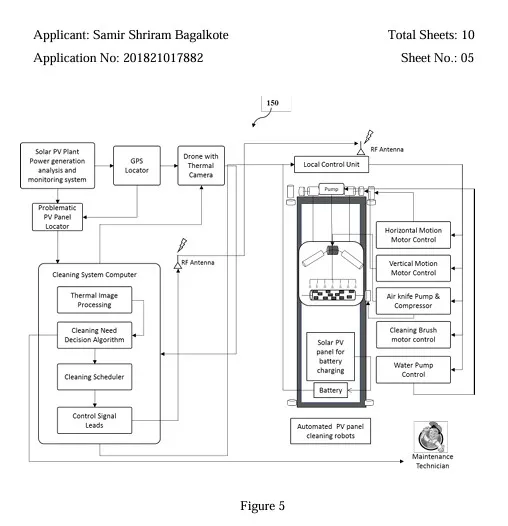
In another aspect, the invention provides an automated method for cleaning PV panels based on performance monitoring and intelligent dirt detection. The SCADA system continuously monitors and analyses power generation data from individual PV panels and/or the entire solar power plant to identify underperforming panels and determine their locations within the array. Upon identification, a secondary scanning system is activated to scan the affected panels, a specified region, or the entire solar array, as required. Image processing and computer-based analysis are employed to assess the type and extent of dust or dirt deposition. Based on the analysis, appropriate cleaning commands are transmitted wirelessly to the robotic cleaning device, either automatically through the control system or through operator-initiated remote control.
The robotic cleaning device subsequently navigates to the identified panels and performs the required cleaning operation using the dry cleaning unit, wet cleaning unit, or a combination thereof, depending on the detected nature and extent of contamination. The synchronized movement of the cleaning module ensures coverage across the panel width and length, enabling targeted and selective cleaning of affected PV panels.
Accordingly, the invention provides an intelligent, automated and selective PV panel cleaning solution that integrates power-generation performance monitoring, image-based dirt assessment, wireless control and robotic cleaning mechanisms. The system facilitates demand-based cleaning, reduces unnecessary cleaning operations, optimizes the utilization of water and cleaning resources, and helps maintain the operational efficiency and power-generation performance of solar photovoltaic installations.
Solar photovoltaic (PV) panels lose their power-generation efficiency over time due to the accumulation of dust, dirt, bird droppings and other environmental contaminants on their surfaces. The extent of this efficiency loss varies depending on geographical location, weather conditions, agricultural and industrial activities, and other environmental factors. In some conditions, power-generation losses can be significant, making regular cleaning essential to maintain the performance of solar power plants.
However, existing cleaning methods have several limitations:
1. Manual cleaning is inefficient: It is labour-intensive, time-consuming and expensive, particularly for large-scale solar installations.
2. Excessive water consumption: Most automated cleaning systems rely on water, often requiring treated or demineralized water to prevent mineral deposits and scaling on panel surfaces. This makes them unsuitable for water-scarce regions.
3. Limited cleaning capability: Waterless cleaning systems can effectively remove loose and dry dust but are less effective against sticky dirt, mud deposits and bird droppings. Conversely, water-based systems may struggle to remove stubborn contaminants without additional cleaning mechanisms.
4. Unnecessary cleaning operations: Most existing automated systems clean the entire solar array irrespective of whether all panels require cleaning, resulting in unnecessary consumption of water, electrical power and operating resources.
5. Lack of intelligent selective cleaning: Existing systems generally lack the capability to automatically identify underperforming or contaminated panels and selectively clean only those panels that require attention. Many systems also require human intervention to initiate cleaning or reposition the equipment between panel rows.
Accordingly, the key problem addressed by the present invention is the absence of an intelligent and fully automated solar panel cleaning solution capable of identifying panels requiring cleaning and selectively removing both dry dust and stubborn sticky contaminants using appropriate dry and wet cleaning mechanisms, while minimizing water consumption, energy usage and unnecessary cleaning operations.
The invention seeks to overcome these limitations by integrating solar plant performance monitoring, contamination assessment and robotic cleaning into a coordinated automated system
The present invention relates to an automated system for cleaning solar photovoltaic (PV) panels arranged in a continuous solar array and a method thereof. More particularly, the invention provides an intelligent, SCADA-integrated robotic cleaning system configured to automatically detect underperforming PV panels, identify their location within the solar array, assess the nature and extent of dust or dirt deposition, and selectively perform dry and/or wet cleaning operations to improve panel cleaning efficiency and maintain optimal power generation.
Existing solar panel cleaning technologies have several limitations, including dependence on manual intervention, periodic or schedule-based cleaning, excessive water consumption and limited effectiveness in removing different types of contaminants. Most existing automated systems clean entire panel rows or arrays irrespective of actual cleaning requirements and lack the capability to identify underperforming panels or assess the nature and extent of contamination before initiating cleaning.
The present invention addresses these gaps through an intelligent, SCADA-integrated robotic cleaning system that continuously monitors power-generation performance, identifies and locates underperforming PV panels, and uses secondary scanning and image processing to assess the type and extent of dust or dirt deposition. Based on this assessment, the system automatically selects and activates an appropriate cleaning mode, comprising dry cleaning, wet cleaning or a combination of both, enabling targeted cleaning of affected panels.
The key technological differentiation lies in the integration of performance-based monitoring, image-based contamination assessment, selective cleaning and a hybrid dry-and-wet robotic cleaning mechanism within a coordinated automated platform. This approach eliminates unnecessary cleaning operations, minimizes water and energy consumption, reduces human intervention and operational costs, and helps maintain optimal power-generation efficiency across solar PV installations.
1. SCADA-Integrated Intelligent Monitoring: Continuously monitors solar panel power-generation performance to identify underperforming panels requiring cleaning.
2. Automated Panel Identification: Identifies and locates affected PV panels within the solar array for targeted cleaning.
3. Image-Based Contamination Assessment: Uses secondary scanning and image processing to assess the type and extent of dust and dirt deposition.
4. Hybrid Dry and Wet Cleaning Mechanism: Integrates dry cleaning for loose dust and wet cleaning for stubborn, sticky dirt and bird droppings within a single robotic platform.
5. Selective and Demand-Based Cleaning: Cleans only identified affected panels or specified regions instead of unnecessarily cleaning the entire solar array.
6. Intelligent Cleaning Mode Selection: Automatically selects dry, wet or combined cleaning based on contamination assessment.
7. Automated Robotic Navigation: Operates through a motorized drive assembly to navigate along PV panel rows.
8. Synchronized Cleaning Mechanism: Provides coordinated transverse movement across the panel width and longitudinal movement along the panel row.
9. Wireless Remote Operation: Supports automated wireless control as well as operator-initiated remote operation.
10. Integrated Onboard Power and Cleaning Resources: Incorporates an onboard battery and reservoir for storing water and cleaning solution.
Key product differentiator: An intelligent, SCADA-integrated robotic cleaning platform that combines performance-based panel identification, image-based contamination assessment, selective cleaning and hybrid dry/wet cleaning in one automated system.
Industries where the invention can be useful?
Company: Taypro Pvt. Ltd. Email: sales@taypro.in Location: Pune / Chakan, Maharashtra Website: https://taypro.in/ Company: Airtouch Solar India Pvt. Ltd. Email: Not publicly verified Location: Noida, Uttar Pradesh Website: https://www.airtouchsolar.com/ Company: Solabot Technologies Pvt. Ltd. Email: sales1@solabot.in Location: Sahibabad, Ghaziabad, Uttar Pradesh Website: https://solabot.in/ Company: Skilancer Solar Pvt. Ltd. Email: contact@skilancersolar.com Location: Faridabad, Haryana Website: https://skilancer.com/ Company: Greenleap Robotics Pvt. Ltd. Email: contact@greenleaprobotics.com Location: New Delhi Website: https://greenleaprobotics.com/ Company: SudoYantra Email: Not publicly verified Location: Delhi Website: https://www.sudoyantra.com/ Company: Helios Cleantech Pvt. Ltd. Email: helioscleantechsm@gmail.com Location: Rajkot, Gujarat Website: https://www.solarpanelcleaningrobot.co.in/ Company: Kiaara Robotics Email: kiaararobotics9@gmail.com Location: Surat, Gujarat Website: https://www.kiaararobotics.com/ Company: Brightbots Pvt. Ltd. Email: info@brightbots.in Location: Gurugram, Haryana Website: https://brightbots.in/ Company: Fabtru Innovation Pvt. Ltd. Email: Not publicly verified Location: Gurugram, Haryana Company: KPI Green OMS Pvt. Ltd. Email: Not publicly verified Location: Ahmedabad, Gujarat Company: SUNAIROBOT Email: sales@sunairobot.com Location: Jaipur, Rajasthan Company: Solavio Labs Pvt. Ltd. Email: Not publicly verified Location: Coimbatore, Tamil Nadu Company: Energy Guru / LeverageNet Solutions Email: Not publicly verified Location: Pune, MaharashtraAn estimate of the total addressable market?
Total Addressable Market (TAM) – India India offers a significant commercial opportunity for the patented automated solar panel cleaning system, driven by rapid solar capacity expansion, dust-related efficiency losses and increasing demand for automated, water-efficient cleaning solutions. - Installed solar capacity: Approximately 174.55 GW (October 2026). - Ground-mounted solar capacity: Approximately 127.33 GW, representing the primary target segment. - Estimated automated solar cleaning market (2026): ₹473–645 crore. - Estimated utility-scale cleaning segment: ₹307–419 crore. - Projected automated cleaning market (2035): ₹2,400–3,400 crore. Market opportunity for the invention: The system can address utility-scale solar parks, industrial and commercial solar installations, and large ground-mounted captive solar plants. Competitive advantage: Integration of SCADA-based performance monitoring, image-based contamination assessment, selective panel cleaning, and hybrid dry/wet cleaning technology. Commercialisation opportunities: Robotic system sales, installation and commissioning, technology licensing, annual maintenance contracts (AMC), and cleaning-as-a-service. Overall assessment: The Indian automated solar cleaning market offers an estimated current opportunity of ₹473–645 crore, with substantial long-term growth potential. The actual addressable market for this invention will depend on its technical suitability, deployment economics and adoption across targeted solar installations.Potential Customers/End Users. Who might benefit?
Potential Customers / End Users – Who Might Benefit? The primary customers and end users of the patented automated solar PV panel cleaning system would be organizations operating or maintaining large-scale solar installations where dust accumulation, water consumption and cleaning costs directly affect power-generation efficiency. 1. Utility-scale Solar Power Developers and IPPs: Companies owning and operating large solar parks and ground-mounted PV power plants, such as Adani Green Energy, ReNew Energy, Tata Power Renewable Energy, NTPC Green Energy, Azure Power and JSW Energy. 2. Commercial and Industrial (C&I) Solar Plant Operators: Manufacturing industries, industrial facilities, warehouses, IT parks, cement plants, steel plants and other organizations operating captive or rooftop solar installations. 3. Solar EPC and O&M Service Providers: Companies responsible for solar plant engineering, installation, operation and maintenance, including robotic cleaning deployment and performance optimization. 4. Government and Public Sector Solar Installations: NTPC, SECI, NHPC, state electricity utilities, government solar parks, railway installations, defence establishments and public infrastructure projects. 5. Solar Asset Management and Facility Management Companies: Organizations managing multiple solar installations and seeking to reduce cleaning manpower, operational expenditure and water consumption. 6. Floating Solar Project Developers: Operators of floating PV installations requiring automated and specialized cleaning solutions, subject to suitable robotic platform adaptation. Primary target customers: Utility-scale solar developers, independent power producers (IPPs), and large solar O&M companies, as they offer the greatest potential for large-volume deployment and recurring service contracts.Documents
-
1794572310470_211.pdf
Actions
Added all portfolio
| Country | Current Status | Patent Application Number | Patent Number | Applicant / Current Assignee Name | Title | Google Patent Link |
| India | Granted and Active | 201821017882 | IN366842 A1 | Samir Shriram Bagalkote | AUTOMATED SYSTEM FOR CLEANING OF SOLAR PHOTOVOLTAIC PANELS IN SOLAR ARRAY AND METHOD THEREOF | Google patent link |
You may also like the following patent
Hybrid Perovskite Flexible Photovoltaic Solar Cell with Tandem / Multi-Junction Design Achieving 50%
| Available For: Taiwan | Renewable Energy |
This invention is a hybrid perovskite-organic flexible solar cell featuring a tandem/multi-junction architecture designed to reach 50% efficiency. By layering advanced materials such as quantum dots,...
| Application Number | M667305 |
| Patent Number | TWM667305U |
| Current Status | Issued |
Thermal Solar Power Panel for generating electricity
| Available For: Egypt | Renewable Energy |
The present invention introduces a novel solar thermal panel technology that integrates multiple heat sources to produce electricity with high density and flexibility. Unlike conventional...
| Application Number | EG/P/2023/943 |
| Patent Number | EG/P/2023/943 |
| Current Status | Pending |

A TWO AXIS SOLAR TRACKING SYSTEM TO TRACK SUN RAYS
| Available For: Canada | Renewable Energy |
Overview The invention relates to a solar panel mounting system that automatically follows the sun’s position throughout the day and across seasons.Problem Conventional fixed-tilt structures and...
| Application Number | 3100975 |
| Patent Number | 40421 |
| Current Status | Granted |
A TWO AXIS SOLAR TRACKING SYSTEM TO TRACK SUN RAYS
| Available For: United States | Renewable Energy |
Abstract / Short Description (Simplified for Non-Experts)This invention is a solar panel mounting system that automatically moves solar panels in two directions so they continuously face the sun...
| Application Number | 16/968, 694 |
| Patent Number | 11114975 |
| Current Status | Granted |
A TWO AXIS SOLAR TRACKING SYSTEM TO TRACK SUN RAYS
| Available For: India | Renewable Energy |
Overview A mechanical solar tracking structure that automatically moves solar panels to follow the sun throughout the day and across seasons.Problem Most solar plants use fixed panels or single-axis...
| Application Number | 201811019035 |
| Patent Number | 449965 |
| Current Status | Granted |