



















Hybrid Perovskite Flexible Photovoltaic Solar Cell with Tandem / Multi-Junction Design Achieving 50%

This invention is a hybrid perovskite-organic flexible solar cell featuring a tandem/multi-junction architecture designed to reach 50% efficiency. By layering advanced materials such as quantum dots, plasmonic nanoparticles, and photonic crystals, it captures a broader spectrum of sunlight. Additionally, it integrates thermoelectric components to convert waste heat into electricity, making it ideal for high-performance, lightweight, and portable applications.
Conventional silicon-based solar cells are rigid and heavy, limiting their use on curved surfaces or portable gear. They also suffer from the "single-junction efficiency limit," where high-energy photons lose energy as heat rather than generating electricity. While existing perovskite or organic cells are flexible, they often struggle with low efficiency and long-term stability.
The solution is a hybrid multi-junction cell that stacks perovskite and organic layers to optimize light absorption across the spectrum. It employs an advanced light management system with quantum dots and photonic crystals to trap photons and a thermoelectric layer to harvest thermal energy. This integrated approach, produced via roll-to-roll manufacturing, achieves record-breaking efficiency while maintaining flexibility and durability.
The invention addresses the "Shockley-Queisser limit" of single-junction cells, which prevents them from converting more than ~33% of sunlight. It also solves the common issue of performance degradation due to heat by integrating thermoelectric materials that turn waste heat back into electrical power.
The invention bridges the gap between high-efficiency (traditionally rigid) and flexibility (traditionally low-efficiency). It introduces a self-healing function and thermal energy harvesting into a single flexible platform, enabling high-power output in environments where traditional solar panels cannot be deployed. Layered/Multi-junction Architecture: Combining perovskite and organic layers, theoretical conversion efficiency reaches 50%.
Integrated Thermoelectric Conversion: Built-in heat sinks and thermoelectric materials convert heat loss into electricity.
Advanced Optical Management: Utilizing quantum dot nanoparticles and photonic crystals to enhance light capture.
Self-Healing and Environmental Resilience: A self-healing polymer matrix extends service life.
Flexible Manufacturing Process: Supports low-cost, large-scale roll-to-roll manufacturing.
Industries where the invention can be useful?
Aerospace、Drone、BIPV、Wearables、Military、EVAn estimate of the total addressable market?
$7 billionPotential Customers/End Users. Who might benefit?
Aerospace: Ultra-lightweight power sources for satellites and drones. Building Integrated Photovoltaics (BIPV): Can be attached to curved glass or irregularly shaped structures in skyscrapers. Wearables: Integrated into clothing, backpacks, or field tents to charge devices. Military: Rapidly deployable field command posts and portable power systems for individual soldiers. Electric Vehicles (EVs): Mounted on vehicle roofs or curved surfaces to increase range.Documents
-
1766214571206_365.pdf
Actions
Added all portfolio
| Country | Current Status | Patent Application Number | Patent Number | Applicant / Current Assignee Name | Title | Google Patent Link |
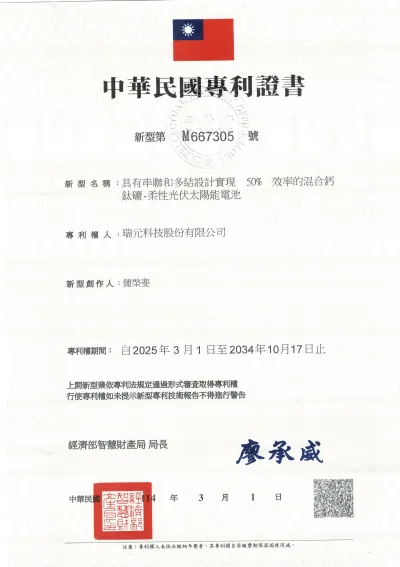
| Taiwan | Issued | M667305 | TWM667305U | Dollarchip Technology Inc. | Hybrid Perovskite Flexible Photovoltaic Solar Cell with Tandem / Multi-Junction Design Achieving 50% Efficiency | Google patent link |
You may also like the following patent
A TWO AXIS SOLAR TRACKING SYSTEM TO TRACK SUN RAYS
| Available For: Canada | Renewable Energy |
Overview The invention relates to a solar panel mounting system that automatically follows the sun’s position throughout the day and across seasons.Problem Conventional fixed-tilt structures and...
| Application Number | 3100975 |
| Patent Number | 40421 |
| Current Status | Granted |
Thermal Solar Power Panel for generating electricity
| Available For: Egypt | Renewable Energy |
The present invention introduces a novel solar thermal panel technology that integrates multiple heat sources to produce electricity with high density and flexibility. Unlike conventional...
| Application Number | EG/P/2023/943 |
| Patent Number | EG/P/2023/943 |
| Current Status | Pending |

A TWO AXIS SOLAR TRACKING SYSTEM TO TRACK SUN RAYS
| Available For: India | Renewable Energy |
Overview A mechanical solar tracking structure that automatically moves solar panels to follow the sun throughout the day and across seasons.Problem Most solar plants use fixed panels or single-axis...
| Application Number | 201811019035 |
| Patent Number | 449965 |
| Current Status | Granted |
A TWO AXIS SOLAR TRACKING SYSTEM TO TRACK SUN RAYS
| Available For: United States | Renewable Energy |
Abstract / Short Description (Simplified for Non-Experts)This invention is a solar panel mounting system that automatically moves solar panels in two directions so they continuously face the sun...
| Application Number | 16/968, 694 |
| Patent Number | 11114975 |
| Current Status | Granted |