



















Contact-Based Bioelectrical Biometric Verification (smartphones)
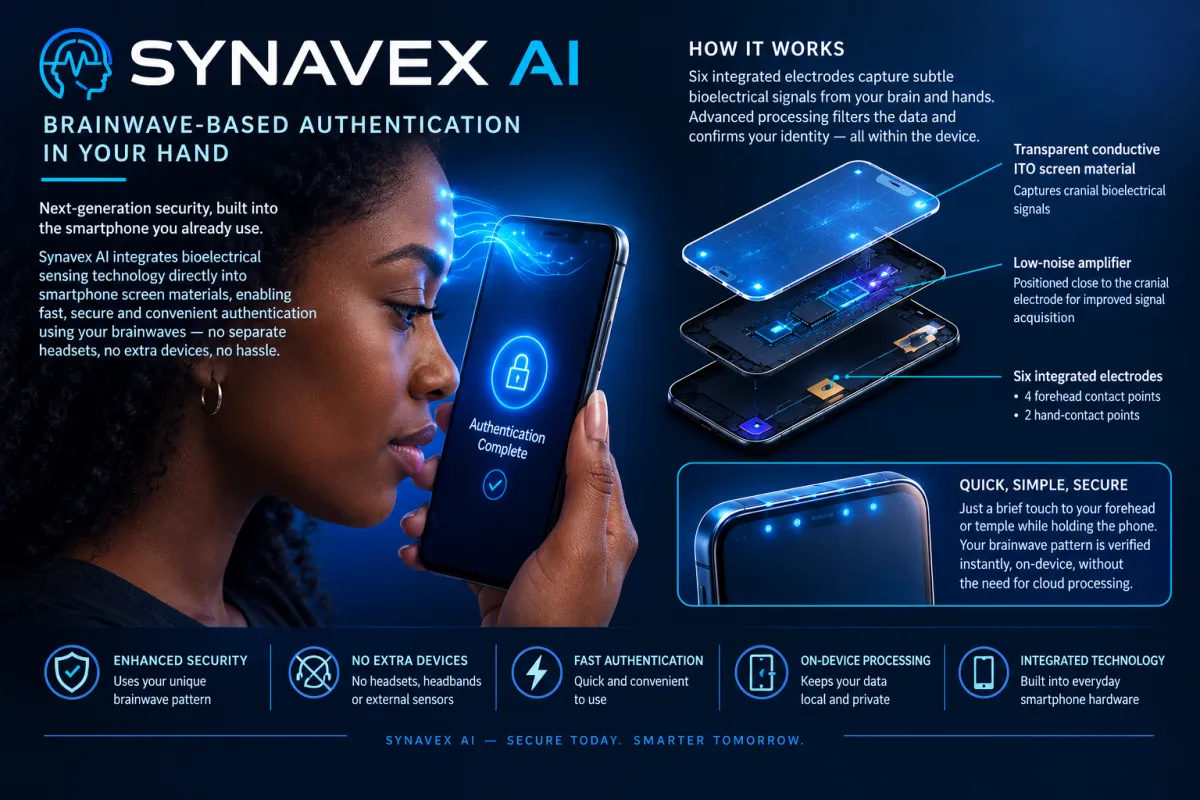
Bioelectrical authentication method integrated into an everyday smartphone, via a brief 1-3 second hand to head contact of phone the phone authenticates the user without needing a password or pin can be used for many applications
EEG brainwave authentication exists however mainly the method that exists requires extra wearbles which are bulky and might not be convenient for everyday authentication
Doesn't require wearbles the system is integrated perfectly into an everyday smartphone device utilizing the materials most major smartphones already use such as ito(induim tin oxide) and Texas instruments ads1299 chip, it's not difficult to integrate this tech system into an everyday smartphone or even the screen glass which is supplied to the manufacturers of everyday smartphones such as Corning company supplies ito glass to apple manufacturers.
Yes. The invention addresses a significant gap in existing prior art: the lack of practical, integrated brainwave-based biometric authentication directly within everyday consumer devices, without requiring separate EEG headsets, headbands or external sensors.
Existing approaches generally rely on dedicated wearable equipment, additional electrodes or conventional biometric methods such as fingerprints and facial recognition. The invention seeks to overcome these limitations by integrating bioelectrical sensing directly into smartphone screen materials and smart-glasses components, enabling rapid, contact-based neural authentication with local signal processing.
This creates an opportunity for more seamless, hardware-integrated authentication across smartphones, smart glasses, mobile banking and secure device access.
Transparent conductive ITO screen material for cranial bioelectrical signal acquisition.
Six integrated electrodes: four forehead contact points and two hand-contact points.
Low-noise amplification positioned close to the cranial electrode.
Differential bioelectrical signal acquisition.
Multi-band signal processing to distinguish neural activity from muscular interference.
Rapid authentication through brief forehead or temple contact while holding the smartphone.
Local signal processing and secure on-device authentication without cloud dependency.
No requirement for separate EEG headsets, headbands or external sensors.
Industries where the invention can be useful?
Banking and Financial Services Fintech Cybersecurity Digital Identity and Authentication Mobile Banking and Payments Financial Technology Enterprise IT and Security Government and Public Sector Defence and Military Technology Aerospace Automotive and Connected Vehicles Healthcare Technology Medical Device Security Insurance E-commerce and Online Retail Digital Wallets and Payment Systems Semiconductor and Microelectronics Display and Touchscreen Manufacturing Smart Home and IoT Security Telecommunications Infrastructure Corporate and Workplace Security Identity Verification and Access ControlAn estimate of the total addressable market?
The long-term opportunity includes licensing or integrating the technology with major smartphone manufacturers, semiconductor companies, display manufacturers and financial technology providers.Potential Customers/End Users. Who might benefit?
Apple Samsung Electronics Google Xiaomi Huawei OPPO vivo HONOR Sony Lenovo / Motorola BOE Technology Corning SCHOTT NEG (Nippon Electric Glass) AGC Inc. Lens Technology Biel Crystal TPK Holding Nitto Denko FujifilmActions
Added all portfolio
| Country | Current Status | Patent Application Number | Patent Number | Applicant / Current Assignee Name | Title | Google Patent Link |
| Uk | Filed | GB2623434.4 | GB2623434.4 | Brook Wendwesen | Synavex ai | Not mentioned |
You may also like the following patent
• Brain-Related Bioelectrical Biometric Verification(smart glasses)"
| Available For: United Kingdom | Semiconductors and Electronics |
Telivra AI is a smart-glasses authentication technology that uses a person's unique brainwave signals (EEG) to verify identity. It integrates transparent conductive electrodes into the lenses and...
| Application Number | GB2624486.3 |
| Patent Number | GB2624486.3 |
| Current Status | Filed |