



















Super Disintegrating Tea Tablet
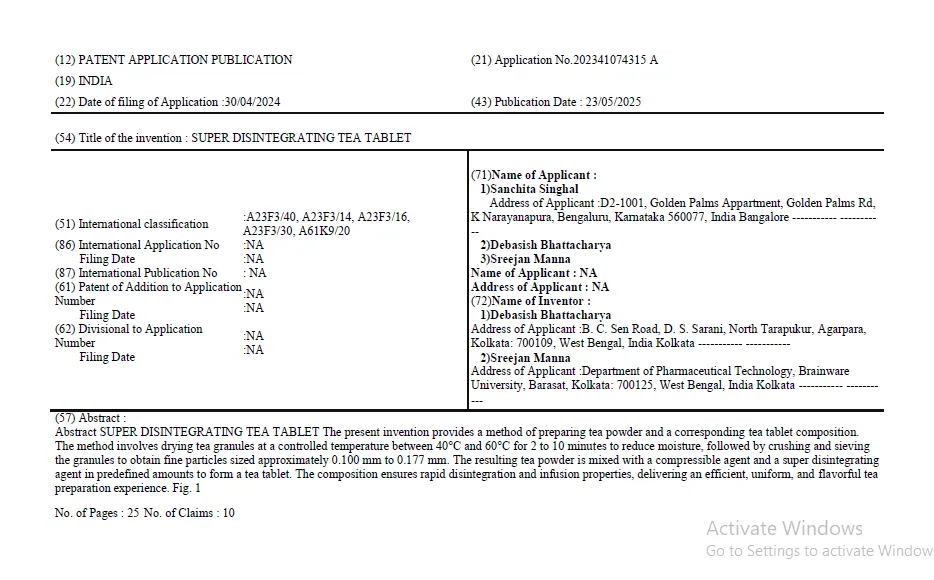
The present invention relates to a composition of a tea tablet and a process of preparing a biconvex-shaped super-disintegrating tea tablet with the composition comprising Tea Powder, Microcrystalline Cellulose, Talc, Magnesium Stearate, and Sodium Starch, which provides an optimum quantity of tea in a tea tablet that can manage the making of tea appropriately and overcome the unnecessary wastage of tea, proper dispersion of tea leaves to make tea liquor, adequate steeping, and to overcome the consumer’s health complications with conventional tea consumption.
The drawback in using conventional tea tablets is that they are not prepared by the direct compression method, do not contain all healthy compounds, do not disperse and/or disintegrate properly into the liquid medium, do not disintegrate within a few seconds, do not fully infuse Flavour, a large amount of wastage, quality of leaves, and consumer flexibility are all not satisfied.
1)The amount of tea powder will be less (200 to 250 mg of tea powder is required for making 100 ml of tea).
2) Fine powder (Sieve 120 can be used, which can produce a 0.125 mm particle size) can be obtained. Therefore, after disintegration, the effective surface area will be greater, resulting in the rapid solubilization of the active ingredient.
3) Extraction of tea liquor will be obtained instantly.
4) Total time of disintegration will be less (Max 30 seconds).
5) The number of ingredients will be less (No requirement for any kind of diluents).
6) Less astringency.
In the first US Patent literature holding the Patent No. US20110159122A1with title "Combination of extracts of various plants for improving the symptoms of dementia disorders", Microcrystalline Cellulose is used as fillers/binders, not as compressible agent; the document fails to discuss whether the obtained tea powder was passed through sieve no. 120 to get uniform-sized particles and crushing using pestle. Also not explains about the obtained mixture was subjected to tablet compression.
The second Patent literature holding the Application No. KR20190036629A with the title " The Puer Tea with Dendro Panax Morbifera Composite" mentions a tea tablet obtained by pressing. But not specific to a bi-convex-shaped tea tablet. The document fails to discuss whether the obtained tea powder was passed through sieve no. 85 to get uniform-sized particles.
The third patent literature holding the Application No. US2009069414W with title "Instantized plant based drink tablets" mentions tea tablet preparation using rooibos as the main tea ingredient but taken up to 300-1000 mg. But not specific to a bi-convex-shaped tea tablet. Magnesium stearate is used as a lubricant and not as a glidant. Sodium starch glycolate is used as a disintegrant. Microcrystalline cellulose is used as either a filler or a disintegrant, but not explained use as a compressible agent is not explained.
The fourth patent literature holding the Application No. CN01113553A with the title "Instant tea tablet and its preparing process" mentions instant tea tablets prepared for different types of tea such as green tea, black tea, blue or green tea, yellow tea, black tea, white tea, oolong tea and jasmine tea, but the range of tea powder used is not given. A disintegrant is used, but not sodium starch glycolate. The invention does not explain how the tea powder was dried in a hot air oven, and the dried tea powder was crushed with the help of a pestle and finely powdered. The invention does not discuss the ingredients Microcrystalline Cellulose, Talc, Magnesium Stearate, and Sodium Starch Glycolate.
Procedural Claims:
- No requirement to isolate the active ingredient separately
- No requirement for any type of chemical treatment
- No requirement for any type of granulation
- No requirement for freeze-drying
- No requirement for spray drying
- No requirement for any lyophilization
- No requirement to produce effervescence
- No requirement of any diluents or fillers (Completely optional)
- No requirement of any type of adulterants
- No requirement of any combinational drug/drugs
- No requirement of centrifugation to separate the fine particles
- No requirement for any purification and concentration of the end product
- Greater hardness
- Prepared tea can be consumed directly
Product Claims:
- The ratio of the chemical compositions
- The amount of tea powder will be less
- Fine powder can be obtained. Therefore, after disintegration, the effective surface area will be more, resulting in the rapid solubilization of the active ingredient
- Extraction of tea liquor will be obtained instantly
- Total time of disintegration will be less (Max 30 seconds)
- The number of ingredients will be lesser (No requirement of any kind of diluents)
- Less Astringency
- Better shelf life
Industries where the invention can be useful?
Food Technology, FMCGAn estimate of the total addressable market?
According to a publicly known market report, the Indian Tea market size was valued at USD 11.1 billion in 2023 and is expected to grow at a CAGR of 3.18% to reach USD 14.7 billion by 2032.Potential Customers/End Users. Who might benefit?
Households, corporates, hotels, etc.
Actions
Added all portfolio
| Country | Current Status | Patent Application Number | Patent Number | Applicant / Current Assignee Name | Title | Google Patent Link |
| India | Under Examination | 202341074315 | Not mentioned | Debasish Bhattacharya | SUPER DISINTEGRATING TEA TABLET | Not mentioned |
You may also like the following patent
Intensely sweet low calorie load sugar
| Available For: India | Food and Agriculture |
A form of Intensely sweet cane sugar suitably fortified with natural stevia to closely mimic the sweetness of sugar, the familiar look and feel of sugar, the first note of sweetness, the mouthfeel,...
| Application Number | |
| Patent Number | 522296 |
| Current Status | Granted |