



















Single-ended DC-to-DC converter
The invention relates to electrical engineering, in particular to single-ended DC voltage converters, and can be used in secondary power supply systems to convert, regulate and stabilize the DC output voltage.
The purpose of the invention is to generate a constant output voltage from a constant input voltage and reduce dynamic losses.
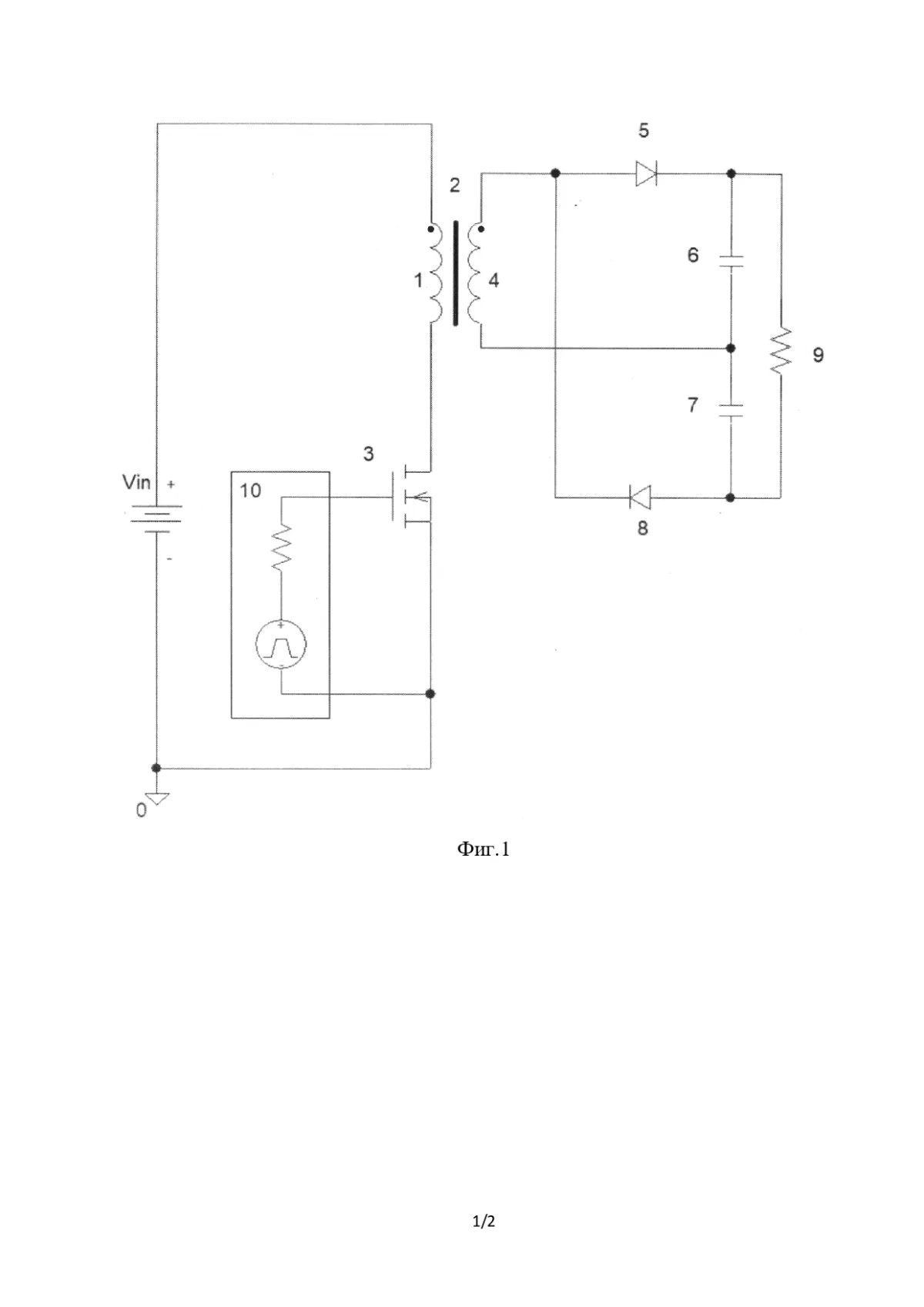
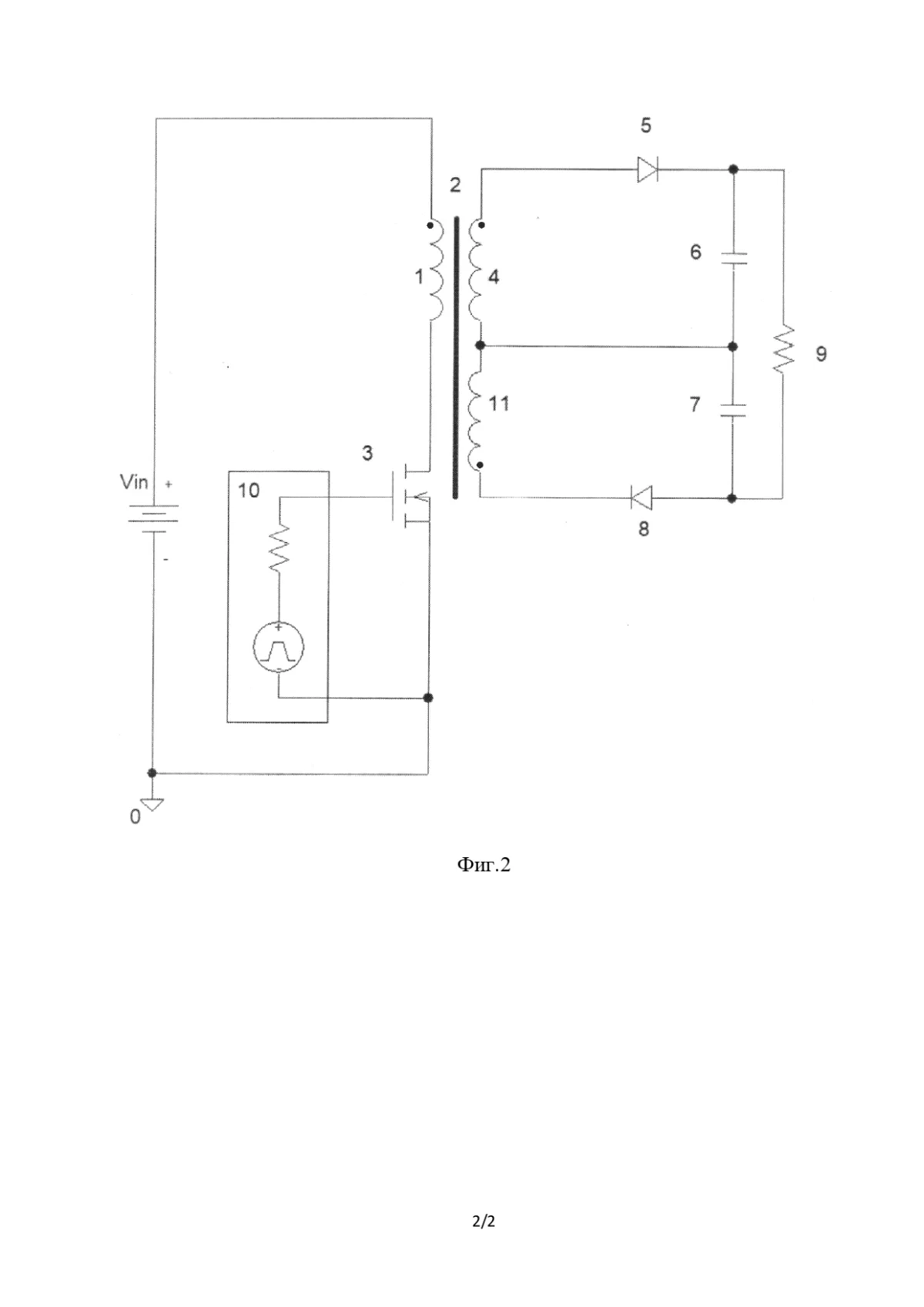
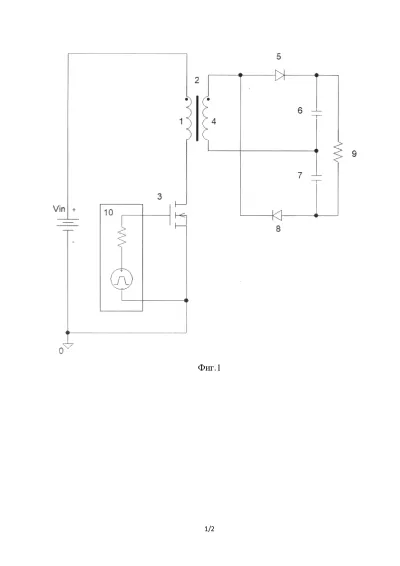
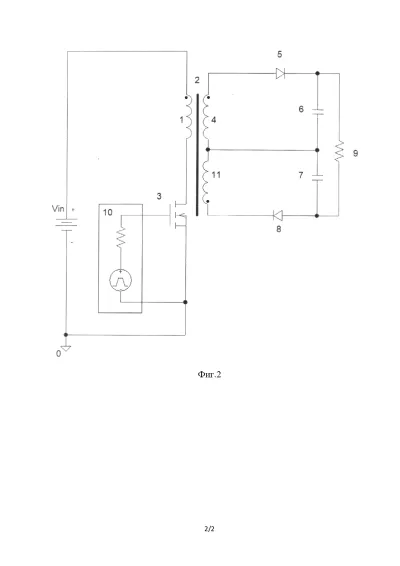
The device contains a control switch 3, implemented in the form of a field-effect transistor (MOSFET), the control electrode of which is connected to a pulse width controller 10. A power transformer 2, the primary winding 1 of which is connected via a control switch 3 to a constant input voltage source, and the secondary winding 4 is connected via rectifier diodes 5,8 to series-connected filter capacitors 6,7, in parallel to which the load 9 is connected.
In the proposed single-ended DC converter, the beginning of the primary winding 1 of transformer 2 is connected to the positive pole of the input DC voltage source, and the end of the primary winding 1 is connected to its negative pole via a switch 3 controlled by a pulse width controller 10. The anode of the rectifier diode 5 is connected to the beginning of the secondary winding 4 of transformer 2, the cathode of which is connected to one of the terminals of capacitor 6. The second terminal of capacitor 6 is connected to the end of winding 4. The end of the winding 4 is connected to one of the terminals of the capacitor 7, the second terminal of which is connected to the anode of the rectifier diode 8, the cathode of which is connected to the beginning of the winding 4. The load 9 is connected in parallel with series-connected filter capacitors 6 and 7.
The invention pertains to the field of electrical engineering, specifically to single-ended DC voltage converters, and can be used in secondary power supply systems to convert, stabilize, and regulate the constant output voltage, which is electrically isolated from the input DC voltage.
There are known DC voltage converters with galvanic separation of the output DC voltage from the DC input voltage [1].
The disadvantage of known DC input voltage converters to constant output voltage is a limited range of output voltage regulation, increased requirements for gaps in the transformer magnetic core, trapezoidal current shape through the control switch, large dynamic losses in the control switch when it is turned on and off.
The closest technical solution to the proposed device is a DC-to-DC converter with energy transfer to the reverse output circuit (Flyback converter), which consists of a primary transformer winding connected to the input DC voltage source through a controlled switch, a secondary transformer winding connected to a rectifier diode and a capacitive filter, with the load connected in parallel to the filter.
The disadvantages of this converter are that it only transfers energy to the load during the time when the control switch is off, which limits the converter's voltage regulation capabilities. Additionally, it requires a significant gap in the magnetic circuit, resulting in associated losses in the transformer. Furthermore, there are significant dynamic power losses in the control switch during the on and off intervals, due to the trapezoidal shape of the current flowing through the control switch.
The object of the invention is to overcome these disadvantages.
The objective is accomplished by the fact that in a single-ended DC voltage converter, the primary winding of the transformer is connected through a control switch to the terminals of the input DC voltage source, the secondary winding of the transformer is connected through a rectifier diode to the first filter capacitor, and through another rectifier diode to the second filter capacitor connected in series with the first filter capacitor, in parallel with which the load is connected.
The proposed single-ended DC voltage converter, in contrast to the existing device, enables the transfer of energy to the load throughout the entire operational period T of the converter, enhancing its control and power capabilities. Due to the specifics of energy transfer to the output circuit in the form of a voltage pulse and a current pulse enables to form a time delay in energy transfer to the output circuit when the control switch 3 is turned on. And thus, it allows to separate the current rise and the voltage drop through the control switch, which significantly reduces the power loss on the switch when it is turned on, and the rectangular form of the current flowing through the switch 3 reduces losses on it when it is turned off.
1. Continuous energy transfer to the load throughout the entire period, unlike the flyback converter.
2. Rectangular current shape through the control switch, which reduces static losses through the control switch.
3. Separation of current and voltage edges, which reduces dynamic losses in the control switch.
4. Use of a single magnetic element
Industries where the invention can be useful?
The power supplies of the proposed types are designed for high-efficiency power supply of the following electronic equipment: - LED lighting equipment - Equipment for managing the fuel and energy complex; - industrial equipment; - Equipment for monitoring the production process; - medical equipment; - transport equipment designed for modern railway infrastructure and electric vehicle infrastructure; - communication and data processing equipment; - Automatic diagnostic and control tools; - Equipment for testing semiconductor devices; - network equipment; - equipment for maintenance of the power grid; - robotics; - aerospace engineering - computer equipment for various purposes, - consumer electronics.An estimate of the total addressable market?
The global market for DC converters was valued at USD 8.3 billion in 2024 and is estimated to grow at an average annual growth rate of 6.1%, reaching USD 14.7 billion by 2034.Potential Customers/End Users. Who might benefit?
Potential customers and end users of DC-DC converters are electronics manufacturers, system integrators, and service companies. They use these components in all areas where DC adaptation, stabilization, or galvanic isolation is required.Documents
-
1784406625758_711.pdf
Actions
Added all portfolio
| Country | Current Status | Patent Application Number | Patent Number | Applicant / Current Assignee Name | Title | Google Patent Link |
| USA | Patent Pending | 19/153,537 | Not mentioned | Polikarpov Vladimir Anatolyevich | SINGLE-ENDED DC-TO-DC CONVERTER | Not mentioned |
You may also like the following patent
DC-DC active clamp converter
| Available For: China | Semiconductors and Electronics |
The invention relates to electrical engineering, in particular to single-ended DC voltage converters, and can be used in secondary power supply systems to convert, regulate and stabilize the DC...
| Application Number | 202480024979.8 |
| Patent Number | |
| Current Status | Patent Pending |
DC-DC active clamp converter
| Available For: India | Semiconductors and Electronics |
The invention relates to electrical engineering, in particular to single-ended DC voltage converters, and can be used in secondary power supply systems to convert, regulate and stabilize the DC...
| Application Number | 202517102832 |
| Patent Number | |
| Current Status | Patent Pending |
Low Voltage DC-DC active clamp converter
| Available For: India | Semiconductors and Electronics |
The invention relates to electrical engineering, in particular DC-DC converters, and can be used in secondary power supply systems to convert, regulate and stabilize the DC output voltage...
| Application Number | 202517109191 |
| Patent Number | |
| Current Status | Patent Pending |
AC-to-DC voltage converter
| Available For: China | Semiconductors and Electronics |
The invention relates to electrical engineering, and more particularly to AC-to-DC voltage converters, and can be used in secondary power supply systems for power factor correction, conversion, and...
| Application Number | 202480015610.0 |
| Patent Number | |
| Current Status | Patent Pending |
Single-ended DC-to-DC converter
| Available For: China | Semiconductors and Electronics |
The invention relates to electrical engineering, in particular to single-ended DC voltage converters, and can be used in secondary power supply systems to convert, regulate and stabilize the DC...
| Application Number | 202480015820.X |
| Patent Number | |
| Current Status | Patent Pending |
AC-to-DC voltage converter
| Available For: United States | Semiconductors and Electronics |
The invention relates to electrical engineering, and more particularly to AC-to-DC voltage converters, and can be used in secondary power supply systems for power factor correction, conversion, and...
| Application Number | 19/153,541 |
| Patent Number | |
| Current Status | Patent Pending |
DC-DC active clamp converter
| Available For: United States | Semiconductors and Electronics |
The invention relates to electrical engineering, in particular to single-ended DC voltage converters, and can be used in secondary power supply systems to convert, regulate and stabilize the DC...
| Application Number | 19/447,985 |
| Patent Number | |
| Current Status | Patent Pending |
Single-ended DC-to-DC converter
| Available For: India | Semiconductors and Electronics |
The invention relates to electrical engineering, in particular to single-ended DC voltage converters, and can be used in secondary power supply systems to convert, regulate and stabilize the DC...
| Application Number | 202517082422 |
| Patent Number | |
| Current Status | Patent Pending |
Low Voltage DC-DC active clamp converter
| Available For: China | Semiconductors and Electronics |
The invention relates to electrical engineering, in particular DC-DC converters, and can be used in secondary power supply systems to convert, regulate and stabilize the DC output voltage...
| Application Number | 2024800319659 |
| Patent Number | |
| Current Status | Patent Pending |
Low Voltage DC-DC active clamp converter
| Available For: United States | Semiconductors and Electronics |
The invention relates to electrical engineering, in particular DC-DC converters, and can be used in secondary power supply systems to convert, regulate and stabilize the DC output voltage...
| Application Number | 19/483,236 |
| Patent Number | |
| Current Status | Patent Pending |
AC-to-DC voltage converter
| Available For: India | Semiconductors and Electronics |
The invention relates to electrical engineering, and more particularly to AC-to-DC voltage converters, and can be used in secondary power supply systems for power factor correction, conversion, and...
| Application Number | 202517082423 |
| Patent Number | |
| Current Status | Patent Pending |