



















Low Voltage DC-DC active clamp converter
The invention relates to electrical engineering, in particular DC-DC converters, and can be used in secondary power supply systems to convert, regulate and stabilize the DC output voltage galvanically separated from the input DC voltage and reduce static and dynamic power losses.
The object of the invention is to generate a low-voltage DC output voltage from a high-voltage DC input voltage and to reduce dynamic and static losses.
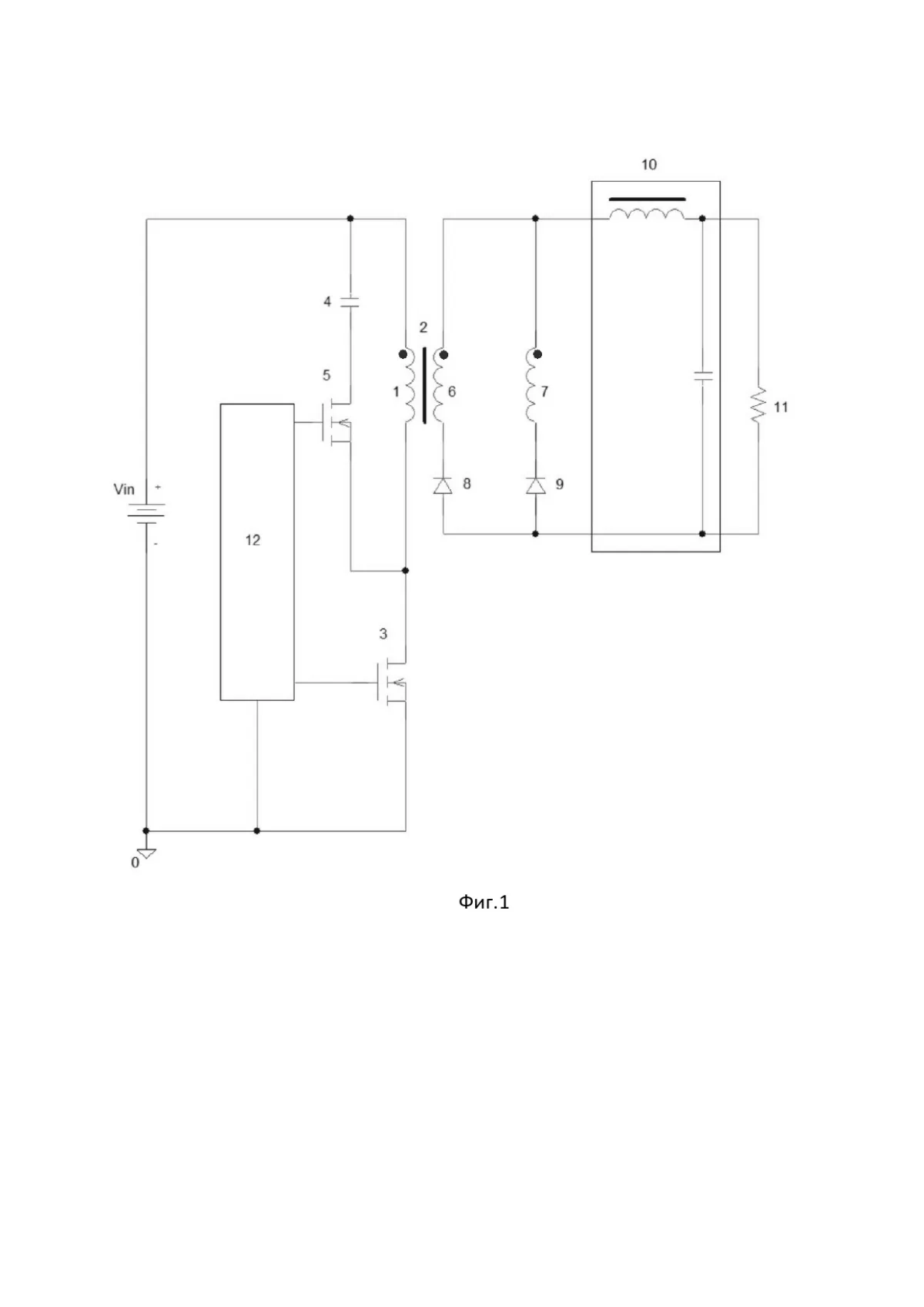
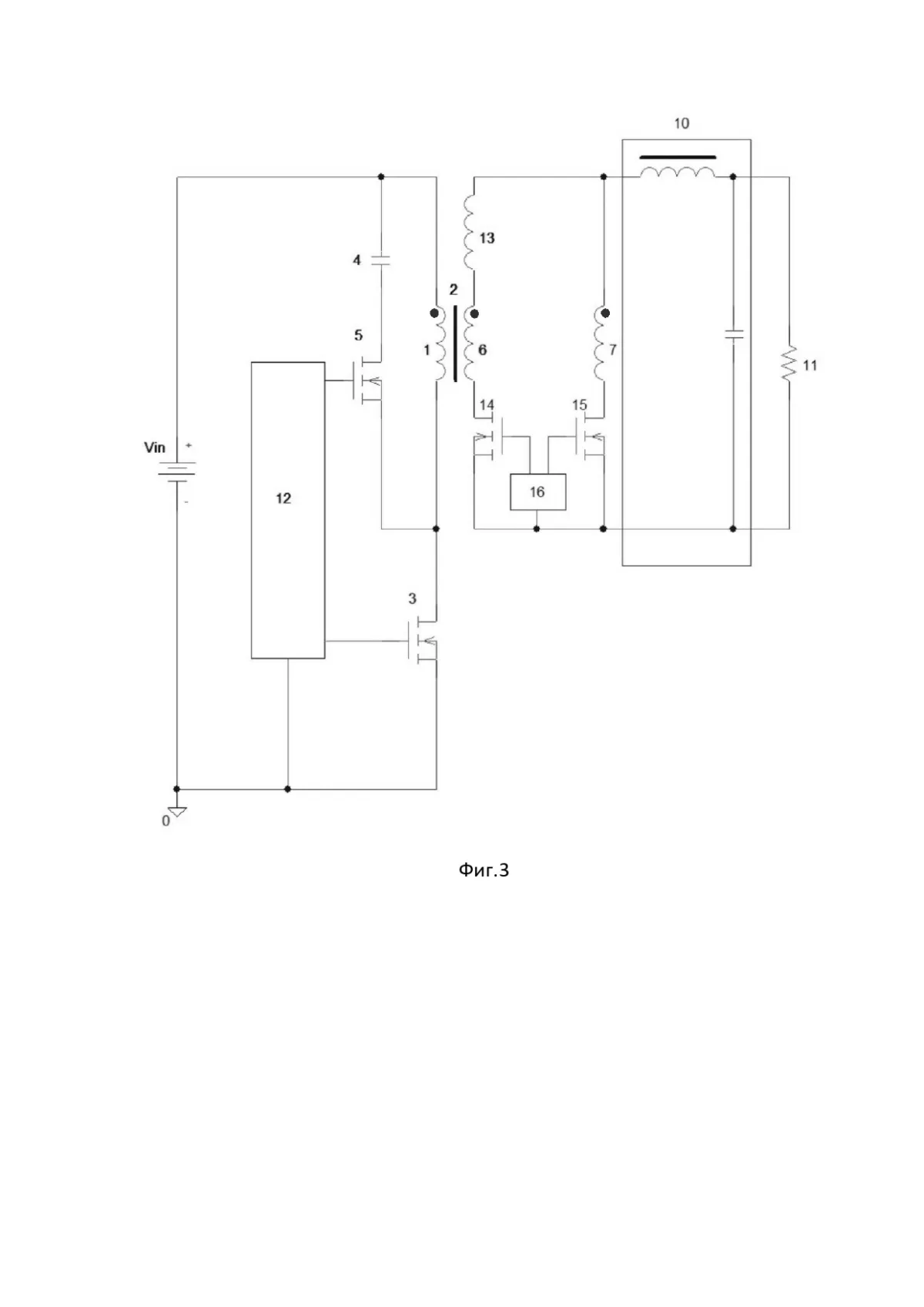
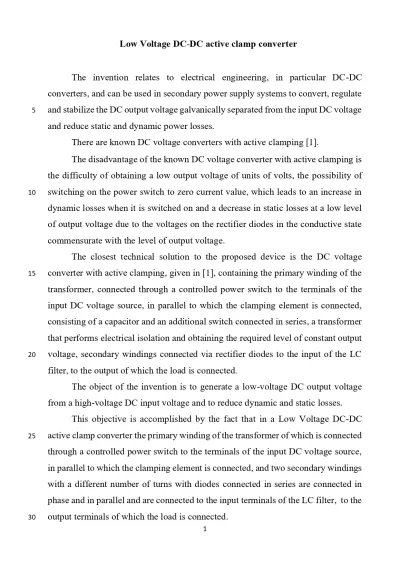
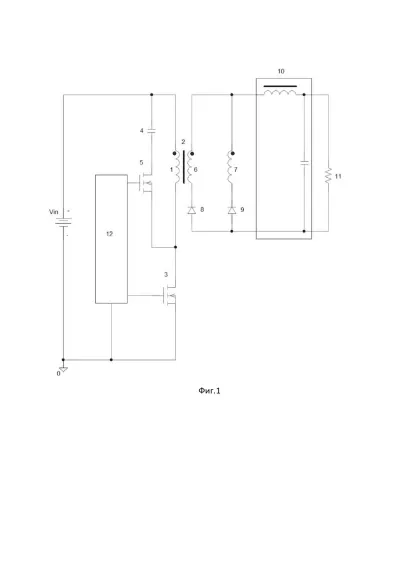
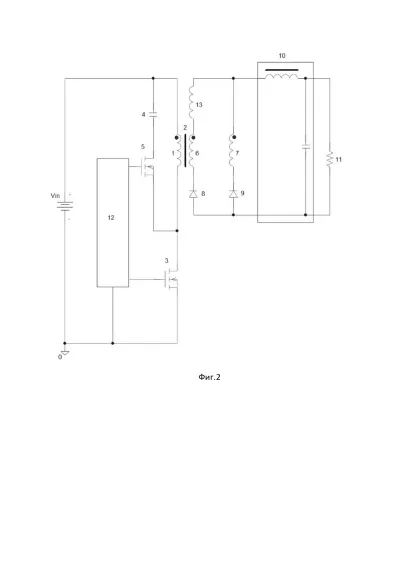
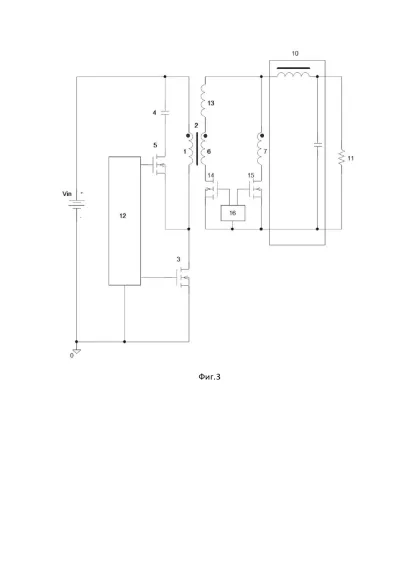
In the device, the beginning of the primary 1 of the transformer 2 is connected to the positive pole of the input DC voltage source, and the end of the primary 1 is connected to the negative pole of the input DC voltage source through a controlled power switch 3, implemented in the form of a MOSFET. In parallel with the primary winding 1 of the transformer 2, connected a clamping element consisting of a capacitor 4 connected in series with an additional switch 5 implemented in the form of a MOSFET. The beginning of the first secondary winding 6 is connected to the beginning of the second secondary winding 7. The end of the first secondary is connected to the cathode of diode 8, and the end of the second secondary winding 7 is connected to the cathode of diode 9, the anodes of diodes 8 and 9 are combined into a common connection point. The common points of the origins of the secondary windings of the transformer and the common connection points of the anodes of diodes 8 and 9 are connected to the input of the LC filter 10, the load 11 is connected in parallel to the output terminals. The control electrodes of the switches 3, 5 are connected to the pulse width controller 12.
The invention relates to electrical engineering, in particular DC-DC converters, and can be used in secondary power supply systems to convert, regulate and stabilize the DC output voltage galvanically separated from the input DC voltage and reduce static and dynamic power losses.
There are known DC voltage converters with active clamping [1].
The disadvantage of the known DC voltage converter with active clamping is the difficulty of obtaining a low output voltage of units of volts, the possibility of switching on the power switch to zero current value, which leads to an increase in dynamic losses when it is switched on and a decrease in static losses at a low level of output voltage due to the voltages on the rectifier diodes in the conductive state commensurate with the level of output voltage.
The closest technical solution to the proposed device is the DC voltage converter with active clamping, given in [1], containing the primary winding of the transformer, connected through a controlled power switch to the terminals of the input DC voltage source, in parallel to which the clamping element is connected, consisting of a capacitor and an additional switch connected in series, a transformer that performs electrical isolation and obtaining the required level of constant output voltage, secondary windings connected via rectifier diodes to the input of the LC filter, to the output of which the load is connected.
The object of the invention is to generate a low-voltage DC output voltage from a high-voltage DC input voltage and to reduce dynamic and static losses.
The objective is accomplished by the fact that in a Low Voltage DC-DC active clamp converter the primary winding of the transformer of which is connected through a controlled power switch to the terminals of the input DC voltage source, in parallel to which the clamping element is connected, and two secondary windings with a different number of turns with diodes connected in series are connected in phase and in parallel and are connected to the input terminals of the LC filter, to the output terminals of which the load is connected.
The proposed Low Voltage DC-DC active clamp converter, in comparison with the known device, makes it possible to form a low-voltage DC output voltage from a high DC input voltage with a decrease in static and dynamic power losses
1. For the first time, it is possible to obtain low output voltages from fractions of a volt to units of a volt from any input voltage.
2. The high coupling coefficient between the primary and secondary windings of the transformer is achieved due to the close to unity transformation ratio.
3. High efficiency is ensured at low output voltages.
4. Active clamping of the primary winding of the transformer ensures ZVS.
Industries where the invention can be useful?
1. Consumer electronics and portable devices. 2. Automotive electronics (Automotive) 3. Industrial automation and IoT (Internet of Things) 4. Telecommunications and server equipment. 5. Medical equipment. 6. Renewable energy.An estimate of the total addressable market?
The global market for DC-DC voltage converters (including the low–voltage segment) in 2026 is estimated at approximately 13.5-15.4 billion US dollars and is showing steady growth at an average annual rate (CAGR) of 6.1% to 9.8% until the mid-2030s.Low-voltage DC-DC converters (input voltage up to 40V/75V or intermediate buses like 48V) make up one of the most widespread and fastest-growing technological segments. They are critically important for lowering the supply voltage of modern microprocessors, control boards, and peripheral systems.Key drivers of growth are automotive electrification: The transition to the architecture of electric vehicles (EV) and hybrids (HEV) with an intermediate low-voltage network of 48V. The converters provide power to the on-board electronics (multimedia, sensors, autopilot systems) from the main traction battery.Telecommunications and 5G: Large-scale deployment of 5G base stations requires efficient on-premises (POL — Point-of-Load) low-voltage converters for powering high-performance communication chips.Portable Electronics and IoT: The constant miniaturization of smartphones, wearable gadgets, and IoT devices requires highly efficient DC-DC (PMIC level) chips to extend battery life.Industrial automation and renewable energy sources: The development of smart factories and renewable energy integration systems (solar panels, local storage) stimulates demand for compact power supply modules for control boardsPotential Customers/End Users. Who might benefit?
Potential customers (B2B) and end users of low-voltage DC-DC voltage converters are electronics manufacturers, system integrators, and equipment developers in areas where stable power supply of components from batteries or internal buses is required. Below is a detailed list of market segments, distributed by application categories.1. Consumer electronics and portable devices.Smart phones, tablets and laptops: converters are needed to power processors, screens and memory modules from the battery (usually 3.7V–11.1V). Smart watches and fitness trackers: ultra-small converters (micro-power PMIC) are critically important for extending autonomy. Portable acoustics and wireless headphones: charge management and power supply of audio chips. Power banks (Power Banks): conversion of voltage of built-in cells (3.7V) to standard USB formats (5V, 9V, 12V, 20V via Power Delivery).2. Automotive electronics (Automotive) Multimedia systems (Information and entertainment complexes): lowering the onboard voltage (12V–24V) to power levels of processors and displays (5V, 3.3V, 1.8V). Driver assistance systems (ADAS) and radars: providing highly stable power supply of video cameras and motion sensors. Electronic control units (ECU): power supply of microcontrollers of motor, brakes and suspension control. Chargers for gadgets in the cabin: built-in USB ports of fast charging.3. Industrial automation and IoT (Internet of Things) Wireless sensors and controllers: powering low-power chips from AA, CR123A batteries or small solar panels. Industrial PLCs (Programmable logic controllers): converting internal 24V DC power bus to low voltages for logic boards. Robotics and CNC machines: stabilizing power supply of sensor systems, encoders and stepper motor control logic.4. Telecommunications and server equipment.Cell base stations and routers: converting standard 48V DC power buses to low-voltage levels for network processors.Data centers (Servers and storage): use of POL-converters (Point-of-Load) directly near powerful CPUs and FPGAs to minimize current losses.5. Medical equipment.Portable medical devices: blood pressure monitors, glucose meters, portable ventilators and ultrasound machines that require high energy efficiency and galvanic isolation for safety.Implantable devices: pacemakers (use ultra-low-power chips).6. Renewable energy.Solar trackers and inverters: powering panel positioning systems and monitoring boards from the generated DC energy.Energy storage systems (ESS): balancing and monitoring lithium-ion or lithium-iron-phosphate battery cells.Documents
-
1784568281240_439.pdf
Actions
Added all portfolio
| Country | Current Status | Patent Application Number | Patent Number | Applicant / Current Assignee Name | Title | Google Patent Link |
| India | Patent Pending | 202517109191 | Not mentioned | Polikarpov Vladimir Anatolyevich | Low Voltage DC-DC active clamp converter | Not mentioned |
You may also like the following patent
Low Voltage DC-DC active clamp converter
| Available For: China | Semiconductors and Electronics |
The invention relates to electrical engineering, in particular DC-DC converters, and can be used in secondary power supply systems to convert, regulate and stabilize the DC output voltage...
| Application Number | 2024800319659 |
| Patent Number | |
| Current Status | Patent Pending |
AC-to-DC voltage converter
| Available For: United States | Semiconductors and Electronics |
The invention relates to electrical engineering, and more particularly to AC-to-DC voltage converters, and can be used in secondary power supply systems for power factor correction, conversion, and...
| Application Number | 19/153,541 |
| Patent Number | |
| Current Status | Patent Pending |
DC-DC active clamp converter
| Available For: India | Semiconductors and Electronics |
The invention relates to electrical engineering, in particular to single-ended DC voltage converters, and can be used in secondary power supply systems to convert, regulate and stabilize the DC...
| Application Number | 202517102832 |
| Patent Number | |
| Current Status | Patent Pending |
DC-DC active clamp converter
| Available For: United States | Semiconductors and Electronics |
The invention relates to electrical engineering, in particular to single-ended DC voltage converters, and can be used in secondary power supply systems to convert, regulate and stabilize the DC...
| Application Number | 19/447,985 |
| Patent Number | |
| Current Status | Patent Pending |
AC-to-DC voltage converter
| Available For: China | Semiconductors and Electronics |
The invention relates to electrical engineering, and more particularly to AC-to-DC voltage converters, and can be used in secondary power supply systems for power factor correction, conversion, and...
| Application Number | 202480015610.0 |
| Patent Number | |
| Current Status | Patent Pending |
Single-ended DC-to-DC converter
| Available For: United States | Semiconductors and Electronics |
The invention relates to electrical engineering, in particular to single-ended DC voltage converters, and can be used in secondary power supply systems to convert, regulate and stabilize the DC...
| Application Number | 19/153,537 |
| Patent Number | |
| Current Status | Patent Pending |
Single-ended DC-to-DC converter
| Available For: India | Semiconductors and Electronics |
The invention relates to electrical engineering, in particular to single-ended DC voltage converters, and can be used in secondary power supply systems to convert, regulate and stabilize the DC...
| Application Number | 202517082422 |
| Patent Number | |
| Current Status | Patent Pending |
Single-ended DC-to-DC converter
| Available For: China | Semiconductors and Electronics |
The invention relates to electrical engineering, in particular to single-ended DC voltage converters, and can be used in secondary power supply systems to convert, regulate and stabilize the DC...
| Application Number | 202480015820.X |
| Patent Number | |
| Current Status | Patent Pending |
DC-DC active clamp converter
| Available For: China | Semiconductors and Electronics |
The invention relates to electrical engineering, in particular to single-ended DC voltage converters, and can be used in secondary power supply systems to convert, regulate and stabilize the DC...
| Application Number | 202480024979.8 |
| Patent Number | |
| Current Status | Patent Pending |
Low Voltage DC-DC active clamp converter
| Available For: United States | Semiconductors and Electronics |
The invention relates to electrical engineering, in particular DC-DC converters, and can be used in secondary power supply systems to convert, regulate and stabilize the DC output voltage...
| Application Number | 19/483,236 |
| Patent Number | |
| Current Status | Patent Pending |
AC-to-DC voltage converter
| Available For: India | Semiconductors and Electronics |
The invention relates to electrical engineering, and more particularly to AC-to-DC voltage converters, and can be used in secondary power supply systems for power factor correction, conversion, and...
| Application Number | 202517082423 |
| Patent Number | |
| Current Status | Patent Pending |