



















Predictive charging controller for electric vehicles
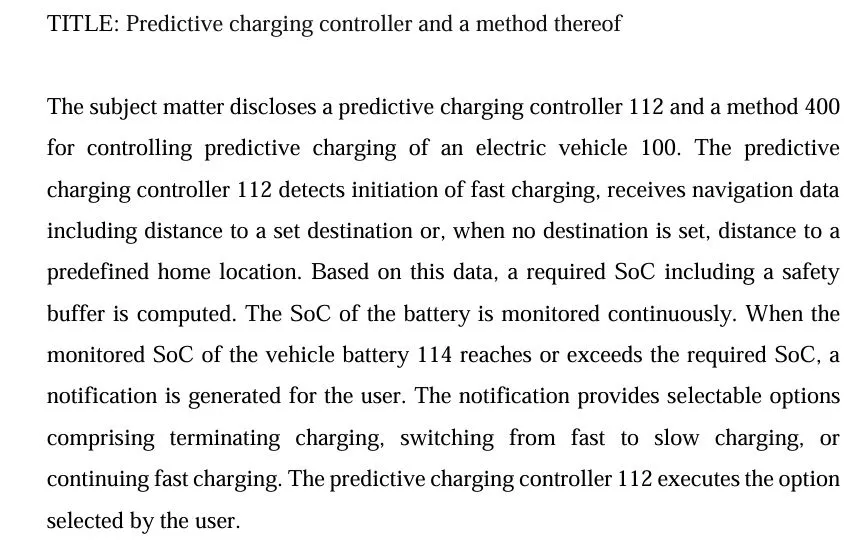
The subject matter discloses a predictive charging controller and a method for controlling predictive charging of an electric vehicle. The predictive charging controller detects initiation of fast charging in a vehicle, receives navigation data including distance to a set destination or, when no destination is set, distance to a predefined home location. Based on this data, a required SoC including a safety
buffer is computed. The SoC of the battery is monitored continuously. When the monitored SoC of the vehicle battery reaches or exceeds the required SoC, a notification is generated for the user. The notification provides selectable options comprising terminating charging, switching from fast to slow charging, or continuing fast charging. The predictive charging controller executes the option
selected by the user.
Problem being solved: In electrical vehicles, there is fast charging and slow charging. Frequent fast charging will degrade the battery. Slow charging causes inconvenience to user because of long charging time.
Benefit:The invention solves the problem by a predictive charging. The charging is monitored, initially the charging mode is in fast charging. Once enough charge+buffer is available to reach preset destination or home, an option is provided to the user to stop fast charging and switch to slow charging or terminate charging. Thus user has option to switch to slow charging thereby eliminating battery degradation and has convenience of fast charging initially.
Problem being solved: In electrical vehicles, there is fast charging and slow charging. Frequent fast charging will degrade the battery. Slow charging causes inconvenience to user because of long charging time.
The invention solves the problem by a predictive charging. The charging is monitored, initially the charging mode is in fast charging. Once enough charge+buffer is available to reach preset destination or home, an option is provided to the user to stop fast charging and switch to slow charging or terminate charging. Thus user has option to switch to slow charging thereby eliminating battery degradation and has convenience of fast charging initially.
The invention solves the problem by a predictive charging. The charging is monitored, initially the charging mode is in fast charging. Once enough charge+buffer is available to reach preset destination or home, an option is provided to the user to stop fast charging and switch to slow charging or terminate charging. Thus user has option to switch to slow charging thereby eliminating battery degradation and has convenience of fast charging initially.
Problem being solved: In electrical vehicles, there is fast charging and slow charging. Frequent fast charging will degrade the battery. Slow charging causes inconvenience to user because of long charging time.
The invention solves the problem by a predictive charging. The charging is monitored, initially the charging mode is in fast charging. Once enough charge+buffer is available to reach preset destination or home, an option is provided to the user to stop fast charging and switch to slow charging or terminate charging. Thus user has option to switch to slow charging thereby eliminating battery degradation and has convenience of fast charging initially.
The subject matter discloses a predictive charging controller and a method for controlling predictive charging of an electric vehicle. The predictive charging controller detects initiation of fast charging in a vehicle, receives navigation data including distance to a set destination or, when no destination is set, distance to a predefined home location. Based on this data, a required SoC including a safety buffer is computed. The SoC of the battery is monitored continuously. When the monitored SoC of the vehicle battery reaches or exceeds the required SoC, a notification is generated for the user. The notification provides selectable options comprising terminating charging, switching from fast to slow charging, or continuing fast charging. The predictive charging controller executes the option selected by the user. Problem being solved: In electrical vehicles, there is fast charging and slow charging. Frequent fast charging will degrade the battery. Slow charging causes inconvenience to user because of long charging time. Benefit:The invention solves the problem by a predictive charging. The charging is monitored, initially the charging mode is in fast charging. Once enough charge+buffer is available to reach preset destination or home, an option is provided to the user to stop fast charging and switch to slow charging or terminate charging. Thus user has option to switch to slow charging thereby eliminating battery degradation and has convenience of fast charging initially.
Industries where the invention can be useful?
Electric vehiclesDocuments
-
1762968245477_980.pdf
Actions
Added all portfolio
| Country | Current Status | Patent Application Number | Patent Number | Applicant / Current Assignee Name | Title | Google Patent Link |
| IN | Application | 202541096793 | Not mentioned | Prakash Balekundri | Predictive charging controller for electric vehicles | Not mentioned |
You may also like the following patent
A vehicle-to-vehicle charging controller
| Available For: India | Automotive and Transportation |
The present disclosure provides a method and a charging controller for vehicle-to-vehicle energy transfer in which the donor vehicle 100 calculates and enforces a reserve state of charge (SoC) of the...
| Application Number | 202541099456 |
| Patent Number | |
| Current Status | Application |