



















A vehicle-to-vehicle charging controller
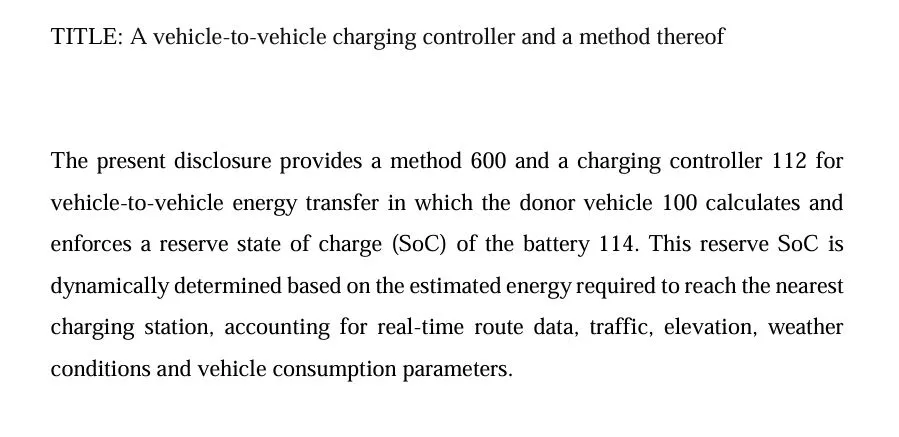
The present disclosure provides a method and a charging controller for vehicle-to-vehicle energy transfer in which the donor vehicle 100 calculates and enforces a reserve state of charge (SoC) of the battery. This reserve SoC is dynamically determined based on the estimated energy required to reach the nearest charging station, accounting for real-time route data, traffic, elevation, weather conditions and vehicle consumption parameters.
Problem being solved: When an electrical vehicle is charging another EV, the charging vehicle does not know when to stop the charging of second vehicle and may end up with low battery at the charging vehicle.
Benefit: The invention makes sure that the first vehicle which is charging second vehicle will not end up with low battery. A minimum battery level is maintained in the first vehicle to reach a nearest charging station+buffer. The invention also takes into account the real-time traffic data, whether data, terrain, energy consumption of first vehicle to reach the nearest charging station and retains minimum charge in the charging vehicle.
Problem being solved: When an electrical vehicle is charging another EV, the charging vehicle does not know when to stop the charging of second vehicle and may end up with low battery at the charging vehicle.
Benefit: The invention makes sure that the first vehicle which is charging second vehicle will not end up with low battery. A minimum battery level is maintained in the first vehicle to reach a nearest charging station+buffer. The invention also takes into account the real-time traffic data, whether data, terrain, energy consumption of first vehicle to reach the nearest charging station and retains minimum charge in the charging vehicle.
The invention makes sure that the first vehicle which is charging second vehicle will not end up with low battery. A minimum battery level is maintained in the first vehicle to reach a nearest charging station+buffer. The invention also takes into account the real-time traffic data, whether data, terrain, energy consumption of first vehicle to reach the nearest charging station and retains minimum charge in the charging vehicle.
When an electrical vehicle is charging another EV, the charging vehicle does not know when to stop the charging of second vehicle and may end up with low battery at the charging vehicle. The invention makes sure that the first vehicle which is charging second vehicle will not end up with low battery. A minimum battery level is maintained in the first vehicle to reach a nearest charging station+buffer. The invention also takes into account the real-time traffic data, whether data, terrain, energy consumption of first vehicle to reach the nearest charging station and retains minimum charge in the charging vehicle.
The present disclosure provides a method 600 and a charging controller 112 for vehicle-to-vehicle energy transfer in which the donor vehicle 100 calculates and enforces a reserve state of charge (SoC) of the battery 114. This reserve SoC is dynamically determined based on the estimated energy required to reach the nearest charging station, accounting for real-time route data, traffic, elevation, weather conditions and vehicle consumption parameters.
Industries where the invention can be useful?
Electric vehiclesDocuments
-
1762967806420_881.pdf
Actions
Added all portfolio
| Country | Current Status | Patent Application Number | Patent Number | Applicant / Current Assignee Name | Title | Google Patent Link |
| IN | Application | 202541099456 | Not mentioned | Prakash Balekundri | A vehicle-to-vehicle charging controller and a method thereof | Not mentioned |
You may also like the following patent
Predictive charging controller for electric vehicles
| Available For: India | Automotive and Transportation |
The subject matter discloses a predictive charging controller and a method for controlling predictive charging of an electric vehicle. The predictive charging controller detects initiation of fast...
| Application Number | 202541096793 |
| Patent Number | |
| Current Status | Application |