



















Next Generation Adaptive Air Purification System
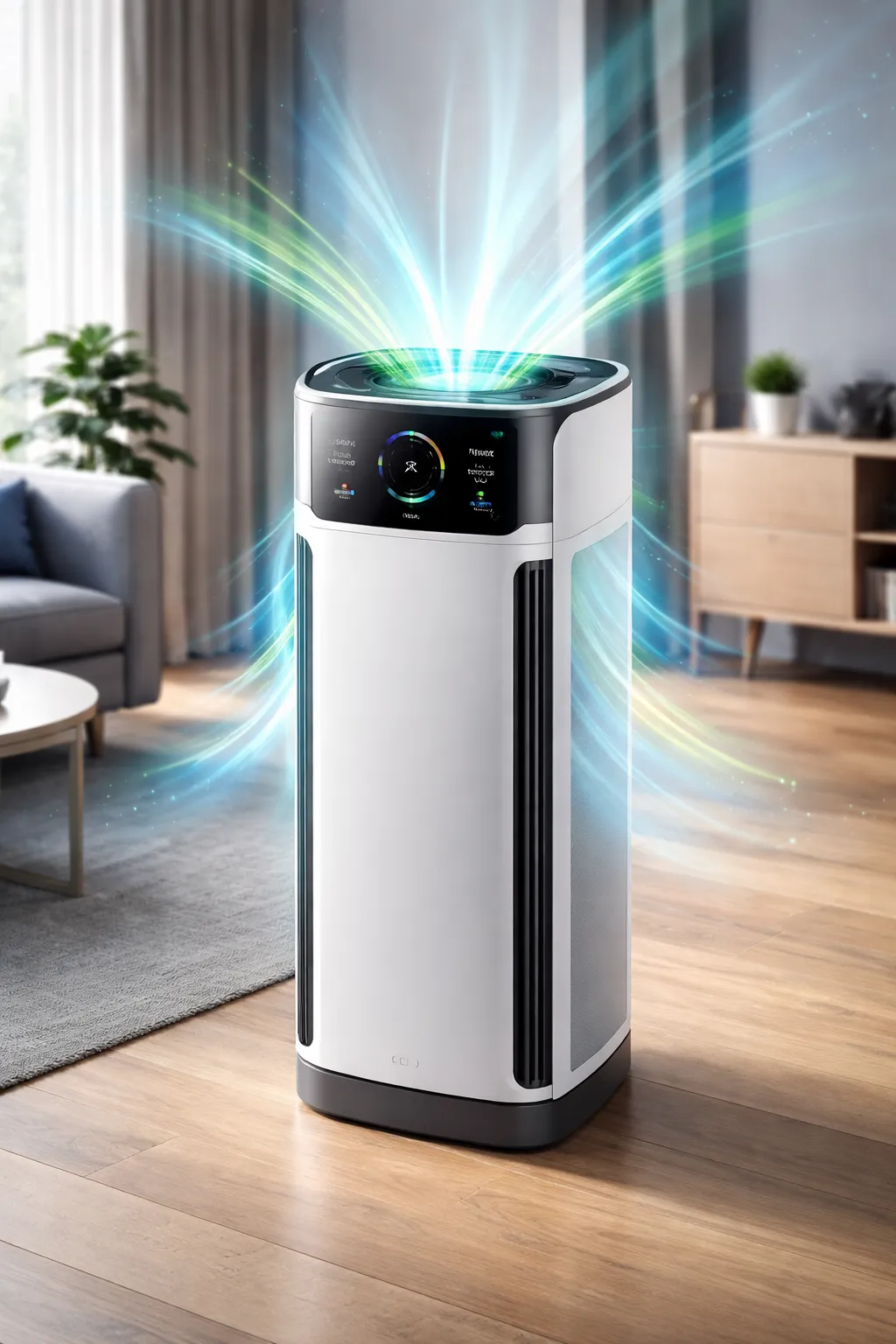
High-efficiency air cleaning solution designed to surpass standard filtration by integrating multi-pollutant removal (simultaneously targeting PM2.5, VOCs, and pathogens) with smart, sensor-driven automation.
Key differentiators include a novel technical mechanism—such as regenerable filtration media or a unique low-resistance airflow geometry—that optimizes clean air delivery (CADR) while minimizing energy consumption and noise. Engineered for safety and convenience, the system features smart-home/HVAC integration, child-safe construction, and measurable performance reporting. It is designed as a high-value intellectual property asset suitable for licensing to major appliance and HVAC manufacturers, targeting health-conscious consumers, medical facilities, and property managers.
The air inside our homes is often dirtier than the air outside, but current machines aren’t smart enough or strong enough to fix it completely.
Specifically, it solves three main issues:
Partial Cleaning: Most standard purifiers catch dust, but they often fail to stop invisible chemicals (like paint fumes), bad odors, or germs that make people sick.
High Maintenance & Waste: Regular filters clog up quickly, lose effectiveness, and are expensive and wasteful to keep replacing.
"Dumb" Operation: Standard devices don't know when the air is dirty. They either run too loud and waste electricity when the air is clean, or they run too slow when pollution actually spikes.
In short: It solves the problem of breathing unhealthy air by replacing weak, disposable, "dumb" filters with a system that catches everything, cleans itself (or lasts longer), and adjusts automatically.
It is a "set-and-forget" solution that transforms indoor air quality management from a manual, high-maintenance chore into an automated, hospital-grade background process.
The major gap in prior art is the lack of a unified, low-maintenance system that treats both physical particles (dust) and chemical/biological threats equally well.
Currently, the market is split:
HEPA filters capture dust but cannot stop gas/odors.
Activated carbon stops odors but saturates quickly and becomes useless (or even releases pollutants back into the air).
UV/Ionizers treat germs but do not remove mass/dust.
The Gap: Prior art generally forces the user to choose between efficacy (buying multiple specialized machines) or convenience (buying one machine that does a mediocre job on non-dust pollutants). There is a lack of integrated solutions that can autonomously detect and destroy all three pollutant categories (PM, VOCs, Pathogens) without requiring frequent, expensive, and wasteful filter replacements.
Based on the gap identified and the solution proposed, here are the unique features of the product/process/service. These are the specific elements that differentiate the invention from existing products and form the basis for patent claims:
-
Integrated Multi-Spectrum Purification Core Unlike standard purifiers that rely solely on passive mechanical filtration (HEPA), this system utilizes a unified capture-and-neutralize chamber. It combines particulate filtration with an active mechanism (such as catalytic oxidation, advanced adsorption, or electrostatic precipitation) to simultaneously remove solid particles (PM2.5), gaseous pollutants (VOCs), and biological pathogens in a single, energy-efficient airflow pass.
-
Adaptive "Pollutant-Specific" Logic The device features a proprietary control algorithm linked to a multi-sensor array. Instead of a simple "Low/High" fan speed, the system identifies the type of pollution present (e.g., a spike in VOCs from cleaning vs. dust from cleaning) and modulates the specific cleaning mode required (e.g., activating a chemical scrubbing cycle vs. increasing mechanical airflow).
-
Regenerable or Self-Sustaining Media Technology To address the high cost and waste of disposable filters, the invention incorporates a mechanism to extend media life or regenerate the filter in situ. This could involve a thermal reset cycle, a wash-and-reuse structure, or a high-capacity capture matrix that resists the rapid saturation common in activated carbon filters.
-
Leakage-Proof Airflow Geometry The housing is engineered with a novel sealing and ducting design that ensures 100% of the air passes through the treatment zone. This eliminates "bypass leakage" (where dirty air slips around the filter)—a common failure point in consumer air purifiers—ensuring the device delivers its rated efficiency in real-world conditions.
-
Verifiable Clean-Air Reporting The system includes an onboard calculation method that translates sensor data into user-verifiable metrics, such as "Mass of Pollutants Removed" or "Remaining Filter Efficiency Percentage." This moves beyond simple color-coded lights, providing actionable data that proves performance and justifies the device's operation.
Industries where the invention can be useful?
Consumer Electronics, Smart HomesAn estimate of the total addressable market?
$5 BillionPotential Customers/End Users. Who might benefit?
1. Health-Focused Consumers: People with asthma, severe allergies, or chemical sensitivities, and families with infants or elderly members who need hospital-grade air. 2. High-Risk Residents: People living in wildfire zones, smoggy urban centers, or near industrial areas who need protection from heavy smoke and traffic exhaust. 3. Commercial & Public Spaces: Medical clinics, dental offices, hotels, and schools that need to actively sterilize air to prevent sickness or quickly remove odors for guests.Documents
-
1765535262414_179.pdf
Actions
Added all portfolio
| Country | Current Status | Patent Application Number | Patent Number | Applicant / Current Assignee Name | Title | Google Patent Link |
| India | Pending For Approval | 12122025 | 01999123 | Anika Singh | Breath Guard | Google patent link |
You may also like the following patent