



















Advanced Medium and High voltage Circuit Breaker
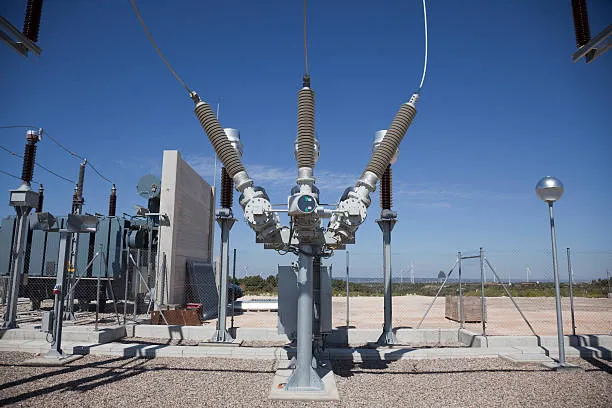
I propose a novel medium- and high-voltage circuit breaker capable of interrupting both alternating current (AC) and direct current (DC) using atmospheric air as the insulation medium. The breaker employs two opposing moving arms that rotate laterally, with nine disconnection points organized in three parallel branches (three points per branch). Auxiliary circuits—including a superconducting fault current limiter (SFCL), a tuning circuit (coil and capacitor), a fast-acting switch, surge arrestor, and rate-of-rise-of-recovery-voltage (RRRV) control—reduce disconnection time, limit short-circuit current, and suppress discharge voltage. The architecture distributes voltage across multiple disconnection points, enabling high-voltage operation with lower per-point stress, and offers potential environmental, cost, and lifetime advantages relative to SF6- or oil-based breakers. Reported mechanism: disconnection within 5–7 ms, with safety margins from distributed insulation and optimized geometry. The manuscript discusses the technical approach, operating principles, and implications for environmental impact and scalability.
[1] The interruption time is relatively long. Sometimes the circuit breaker cannot disconnect large electrical currents, as the disconnection contacts may get hot to the point of sticking together or even melting, and the circuit breaker may explode.
[2] Medium voltage circuit breakers cannot take place of high voltage circuit breakers. As the circuit breaker is exposed to a discharge voltage greater than the system voltage during the process of disconnecting the circuit and the value may reach 160%.
[3] Oil-based circuit breakers or sulfur hexafluoride gas may leak, leading them to stop their work or causing severe pollution in the atmosphere. This is in addition to their high cost, and air is not used in the case of high and ultra-high voltages, but this problem has been solved with this invention, which relies on disconnection points. Consecutive and parallel branches and the breaker arms can move up, down, right and left.
[1] The electrical circuit breaker is developed with this invention to consist of two parts that move up and down and rotate on opposite sides at an angle ranging from 45 to 90 degrees in order to reduce the value of the electric spark and increase the speed of its extinction. The circuit breaker consists of successive stages of disconnection points in parallel branches so that medium voltage circuit breakers can operate at high voltages. Adding auxiliary circuits to reduce the disconnection time and reduce the value of the short circuit current, as well as the discharge voltage when a short circuit occurs. These circuits are extremely important in the case of continuous current. The circuit breaker relies on air as an electrical insulation medium to extinguish the spark and as an alternative to oil and sulfur hexafluoride gas, which pollutes the air, and also to reduce the cost and price of circuit breakers.
Yes, it has major gap in prior art as [1] it can work for both AC & DC systems and in MV & HV levels of voltages. [2] The circuit breaker relies on air as insulation medium (as a medium to suppress the electric spark) and on the presence of auxiliary circuits to reduce the disconnection time and reduce the values of the short-circuit current and the electrical discharge voltage.
[3] The circuit breaker can consist of successive phases of disconnection points in the case of high voltages to distribute the voltage to those points. [4] It can trip the fault within range of 4-7 ms.
[1]The advanced medium and high voltages circuit breaker can handle both alternating current and direct current. It is characterized by using air as a medium to extinguish the electrical spark. It consists of successive stages and parallel branches of disconnection points in the case of high voltages to distribute the voltage to those points. It can disconnect the current in a period with maximum time of seven milliseconds. There are auxiliary circuits for each disconnection point to reduce the value of the disconnection time, short-circuit current, and discharge voltage. The arms of the breaker are movable, one of them moves up and the other down, and one of them moves to the right and the other to the left by an angle ranging from 45 to 90 degrees. This breaker is also distinguished by the presence of an auxiliary element which is called superconducting fault current limiter (SFCL), it helps to reduce the value of the short circuit to values as low as 10% of the value of the original short circuit. [2]The advanced medium and high voltages circuit breaker according to the first claim depends on the natural air as an insulating medium to extinguish the electric spark in medium and high voltages because this circuit breaker consists of nine disconnection points, three in a series position, forming a branch, and they are three branches in parallel (element No. 3 in the drawing boards), which makes the voltage divided by the three disconnection points and the current in the normal state or even the short circuit current is also divided by the three branches, and this circuit breaker is also distinguished by the fact that it can replace the disconnection pieces in medium voltage and use them in high voltage due to its composition of multiple disconnection points, which makes each disconnection point exposed to one-ninth of the system voltages. For example, if the system voltage is 220 kilovolts, which is a high voltage, then the voltage of each disconnection point is about 24.4 kilovolts, which is a medium voltage. [3]The advanced medium and high voltages circuit breaker according to the first claim, as the two arms of the circuit breaker (element No. 11 and element No. 13 in the drawing boards) are movable, and one moves up and the other down using motors. [4]The Advanced medium and high voltages circuit breaker according to the first claim, where the two arms of the circuit breaker are tilted to the right and the other to the left (item No. 11 and item No. 13 in the drawing boards) at an angle ranging from 45 to 90 degrees relative to their meeting point in order to reduce the value of the electric spark resulting from the disconnection process and to increase the speed of extinguishing the spark. [5]The Advanced medium and high voltages circuit breaker according to the first claim, where this circuit breaker is characterized by its small size compared to its counterparts, where the distance between the disconnection points ranges from 35 to 45 centimeters. [6]The Advanced medium and high voltages circuit breaker according to the first claim, where this circuit breaker is characterized by the presence of auxiliary circuits to reduce the disconnection time and reduce the short-circuit current and discharge voltage values, such as the superconducting fault current limiter, which reduces the short-circuit current value to 10% of the original short-circuit current value (item No. 2 in the drawing boards). [7]The advanced medium and high voltages circuit breaker according to the first claim, where each disconnection point has its own auxiliary circuit to reduce the short-circuit current and voltage on the contacts of that point during the disconnection of the short-circuit current, and this circuit consists of a capacitor and a resistor (element No. 14 and element No. 15). [8]The advanced medium and high voltages circuit breaker according to the first claim, where it can disconnect the short-circuit current in a period of time ranging from five milliseconds to seven milliseconds. [9]The advanced medium and high voltages circuit breaker according to the first claim, where it is characterized by a long life and increased efficiency of the breaker because it is exposed to short-circuit currents and discharge voltages less than those exposed to its counterpart based on sulfur hexafluoride gas or oil, thanks to the method of forming the breaker from moving contacts located in successive stages, as well as the auxiliary circuits, where the breaker in this invention is exposed to a discharge voltage of no more than 105% of the system voltage value, which is much less than what other circuit breakers are exposed to. [10]Low cost compared to its counterpart based on sulfur hexafluoride gas. Speed of interruption of current compared to its counterpart based on oil or sulfur hexafluoride gas. The decrease in the value of the short circuit current and the discharge voltage to which the circuit breaker is exposed when a short circuit occurs compared to its counterpart based on oil or sulfur hexafluoride gas. The circuit breaker is environmentally friendly and does not pollute the air due to its reliance on air as a medium for electrical insulation, compared to its counterpart that relies on oil or sulfur hexafluoride gas, which pollutes the air and increases the temperature of the planet. Longevity and increased efficiency of the breaker because it is exposed to short circuit currents and discharge voltages less than those to which its counterpart based on oil or sulfur hexafluoride gas is exposed, thanks to the way the breaker is formed from moving points located in successive stages, as well as auxiliary circuits. The breaker can work with alternating current as well as direct current when auxiliary circuits are added to it. The circuit breaker consists of successive disconnection points and parallel branches, which allows it to be used at all medium and high voltages. Also, the disconnection arms move up and down, right and left, which speeds up the disconnection process and reduces the value of electrical sparks.
Industries where the invention can be useful?
Circuit Breakers manufacturers, power plants, substations,An estimate of the total addressable market?
12000000000Potential Customers/End Users. Who might benefit?
Circuit Breakers manufacturers, power plants, substations, electrical equipment manufacturer
Documents
-
1765034167075_102.pdf
Actions
Added all portfolio
| Country | Current Status | Patent Application Number | Patent Number | Applicant / Current Assignee Name | Title | Google Patent Link |
| Egypt | Pending | EG/P/2022/1486 | EG/P/2022/1486 | Mahmoud Ahmed Saad | Advanced Medium and High voltage Circuit Breaker | Not mentioned |
You may also like the following patent
Semi-Rotational DC Voltage Transformer
| Available For: Egypt | Energy and Utilities |
This is to introduce a novel semi-rotational DC voltage transformer (Patent number:- EG/P/2025/1182) designed for efficient and inexpensive conversion of DC voltages from high to low and vice...
| Application Number | EG/P/2025/1182 |
| Patent Number | EG/P/2025/1182 |
| Current Status | pending |