



















System and Method for a Secured Access to a Platform
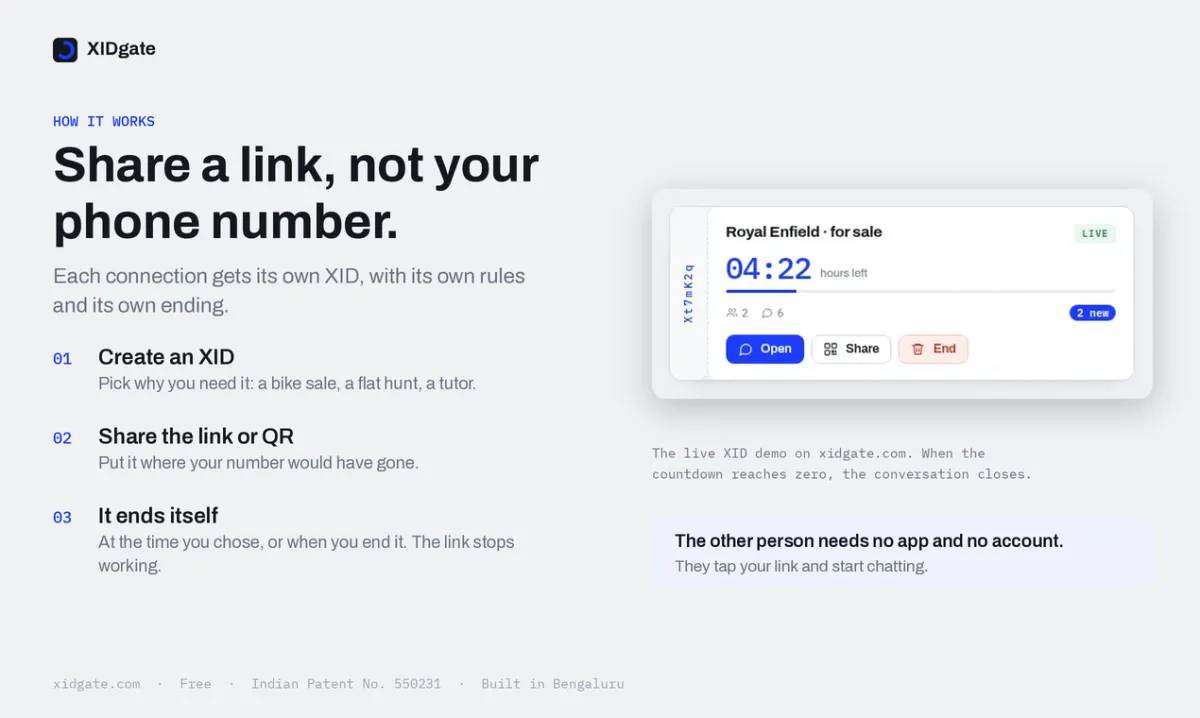
Granted Indian patent on context-specific virtual identities: a person shares a relationship-specific ID (e.g. @rahul/rental) instead of their phone number or email, with permissions for who can reach them, why, how and until when, plus automatic expiry and revocation. Live product: XID (xidgate.com). Fits number masking, marketplaces (rentals, matrimony, classifieds, delivery, ride-hailing), CPaaS and DPDP consent use cases. XID trademark (classes 9, 35, 38, 45) and working product can be bundled. Contact: message4nakul@gmail.com.
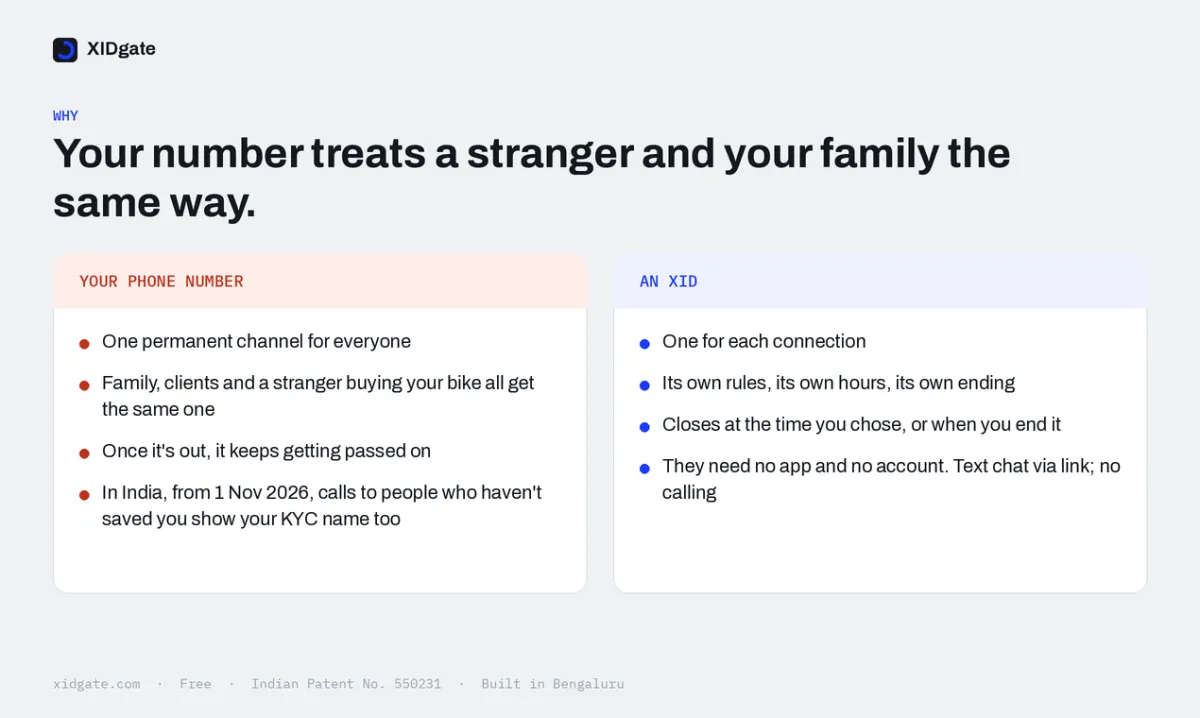
Sharing a phone number or email to enable access (to a platform, a service, a conversation) leaks that identity permanently: it can be reused, forwarded, scraped, and abused for spam, phishing, harassment, and data-broker profiling. There is no practical way for a person to grant another party time-bound, purpose-bound, relationship-bound access without handing over a core identifier. This is a structural problem across marketplaces (rentals, matrimony, classifieds, delivery, ride-hailing), CPaaS communications, and DPDP/privacy-consent workflows, and current number-masking and OTP flows do not address identity, scope, duration or revocation.
The invention lets a person share a context-specific, relationship-specific virtual identity (a handle such as @rahul/rental) rather than their phone number or email. The recipient can reach the person only within the permissions the person set — who can reach them, for what purpose, by which channel, and until when — with automatic expiry and revocation baked in. This preserves reachability for legitimate use while removing permanent exposure of core identifiers, and it applies across the sharing, communications, and consent layers of any platform. Live product: XID (xidgate.com); XID trademark (classes 9, 35, 38, 45) and working product can be bundled.
Yes. Existing approaches (number masking, virtual numbers, OTP/session relay, anonymized email aliases, zero-knowledge contact discovery) each address only part of this: they hide a phone number or route a call, but do not model the relationship context, do not express purpose/channel/duration/revocation as first-class permissions on an identity, and are not designed to plug into marketplace, CPaaS and DPDP-consent workflows as a composable identity layer. The gap is an identity-layer primitive that carries who/why/how/until-when permissions and lifecycle (expiry + revocation) with the shared reference itself — which this patent defines and which is embodied in the XID product.
Relationship-scoped virtual identities (e.g. @rahul/rental) shared in place of phone/email; permissions that encode who can reach the person, why (purpose), how (channel) and until when (time-bound) with automatic expiry and revocation; drop-in fit for number-masking, marketplace onboarding/messaging, CPaaS communication flows and DPDP-style consent workflows; realised as a working product (XID, xidgate.com) with the XID trademark (classes 9, 35, 38, 45) available to bundle.
Industries where the invention can be useful?
IT / software / cybersecurity; number masking; marketplaces (rentals, matrimony, classifieds, delivery, ride-hailing); CPaaS communications; DPDP privacy-consent and data-protection workflows.Documents
-
1793466195417_47.pdf
Actions
Added all portfolio
| Country | Current Status | Patent Application Number | Patent Number | Applicant / Current Assignee Name | Title | Google Patent Link |
| India | Granted | 202141007775 | 550231 | Nakul Ramachandran | System and Method for a Secured Access to a Platform | Not mentioned |
You may also like the following patent