















Stop Outages Before They Happen
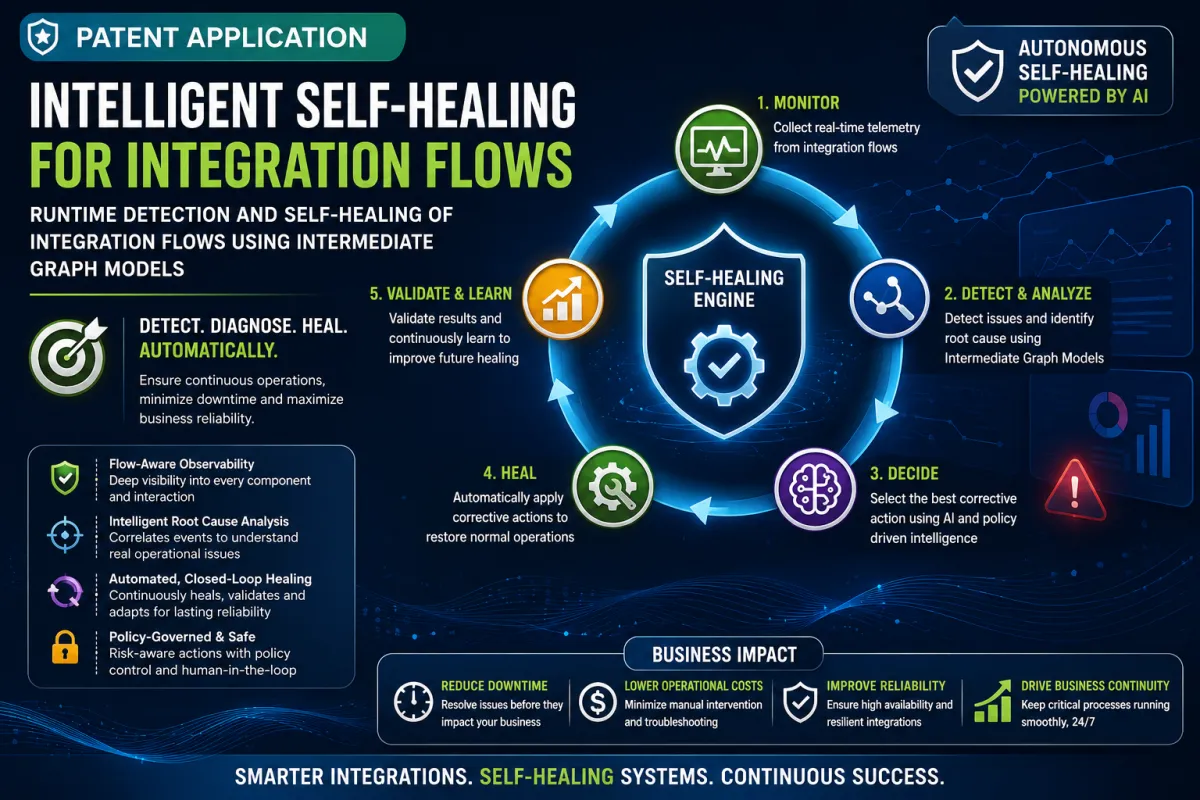
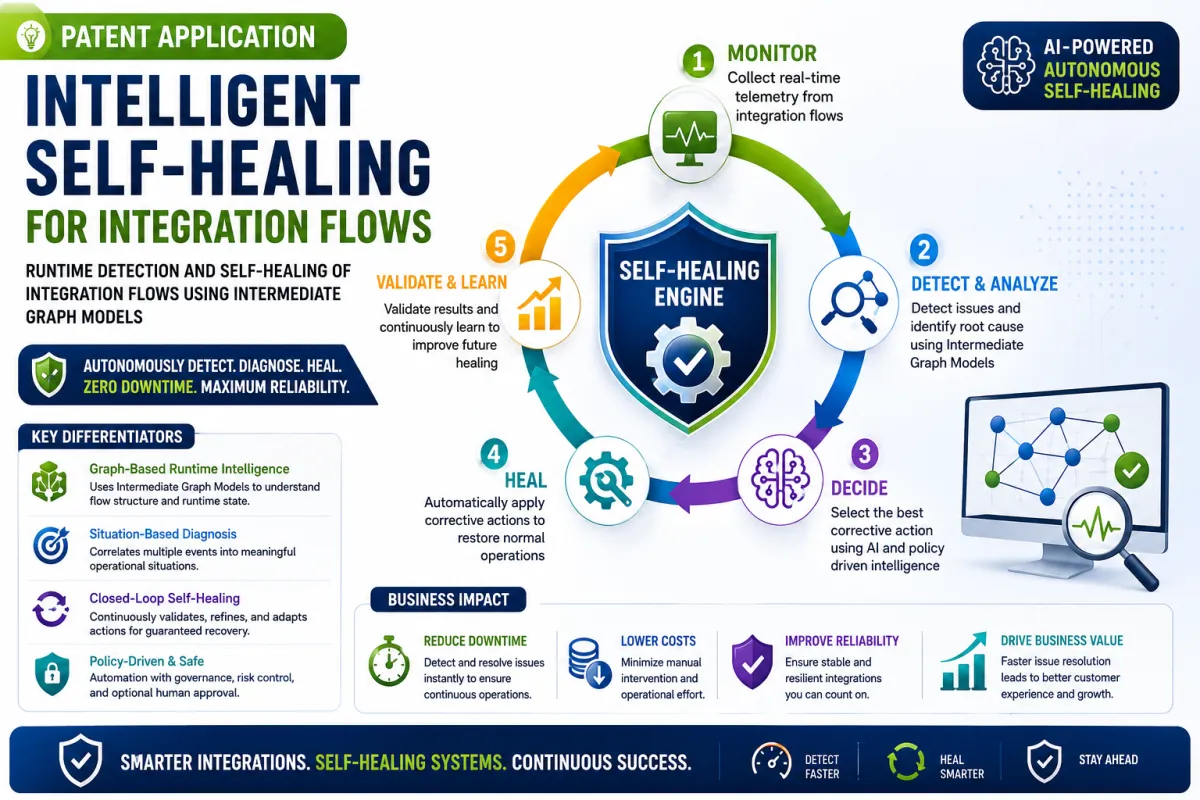
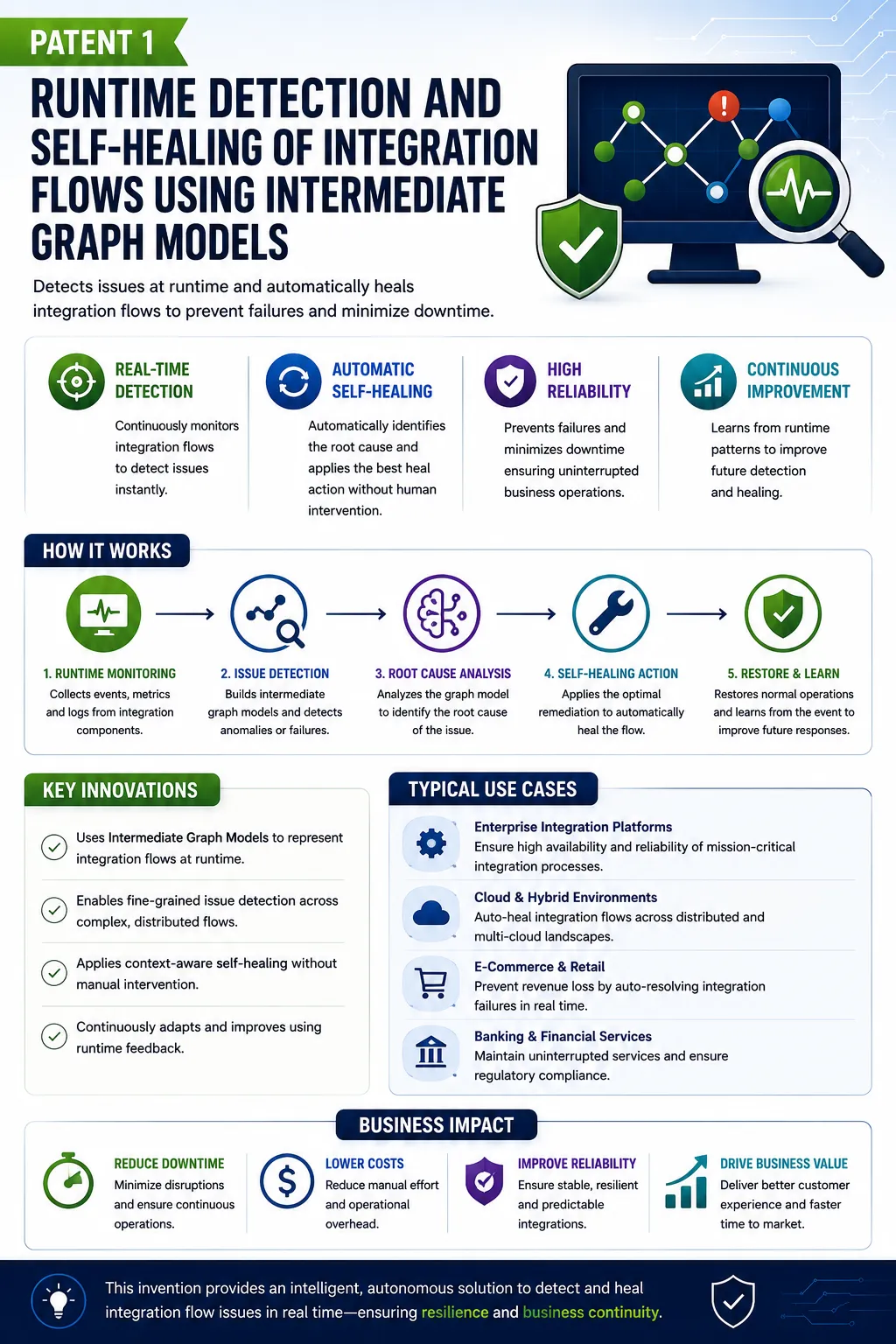
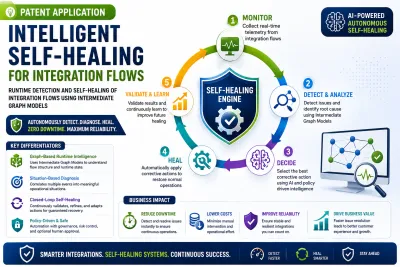
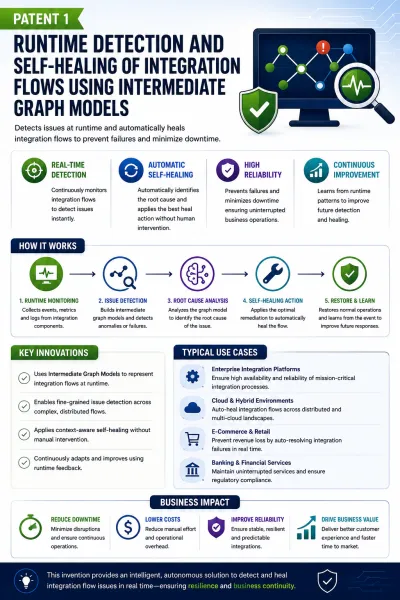
The invention is an intelligent system that continuously monitors enterprise integration software, automatically detects operational problems, identifies their root causes, and applies appropriate corrective actions without requiring manual intervention. Instead of simply reporting errors, the system understands how different parts of an integration flow are connected using an Intermediate Graph Model (IGM), determines the actual operational issue, and automatically restores normal operation. This enables enterprise integration systems to become more reliable, resilient, and self-healing while reducing downtime and operational effort.
Modern businesses depend on enterprise integration platforms to connect applications, cloud services, databases, and APIs. When these integration flows experience problems such as high latency, memory issues, connection failures, excessive retries, or increasing error rates, existing monitoring tools generally generate alerts but do not identify the real cause of the problem or automatically resolve it.
As a result, engineers must manually analyze logs, monitoring dashboards, and runtime metrics to determine which part of the integration flow is responsible for the issue. This process is time-consuming, requires specialized expertise, and often results in prolonged outages and service disruptions.
Another limitation is that existing monitoring systems primarily observe infrastructure metrics such as CPU, memory, or network utilization without understanding the structure and execution logic of the integration flows. Consequently, they cannot accurately correlate multiple runtime events into meaningful operational situations or determine the most effective corrective action.
The invention addresses these limitations by providing flow-aware monitoring, intelligent diagnosis, and automated recovery, thereby reducing manual troubleshooting, minimizing downtime, improving system reliability, and enabling continuous operation of enterprise integration environments.
The invention introduces an intelligent runtime management system that represents deployed integration flows as Intermediate Graph Models (IGMs), where nodes represent integration components and edges represent execution paths or interactions. The system continuously collects runtime telemetry such as latency, resource usage, throughput, error rates, queue depth, and retry information and associates this information with the corresponding graph elements.
By analyzing these runtime-annotated graph models, the system identifies undesirable events and correlates them into higher-level operational situations instead of treating each alert independently. Based on the identified situation, the system determines multiple possible corrective actions, evaluates them using predefined criteria such as effectiveness, risk, policy constraints, historical outcomes, and operational cost, and deploys the most appropriate action.
After applying the corrective action, the system continuously monitors the results to verify whether the issue has been resolved. If the selected action does not produce the desired improvement, the system can modify, replace, or revert the action, thereby creating a closed-loop self-healing mechanism. Depending on organizational policies, corrective actions may also require human approval before deployment.
This approach transforms enterprise integration environments from passive monitoring systems into intelligent, self-healing systems capable of automatically detecting, diagnosing, correcting, and validating runtime issues.
Yes.
Existing enterprise monitoring and observability solutions primarily provide infrastructure-level monitoring by reporting metrics, logs, traces, and alerts. Although these tools can detect abnormal behavior, they generally do not understand the structure of enterprise integration flows, cannot correlate multiple runtime events into meaningful operational situations, and cannot automatically determine and execute corrective actions.
The invention addresses this gap by introducing a graph-based representation of integration flows that combines structural information with runtime telemetry. This enables the system to understand how integration components interact, identify higher-level operational situations rather than isolated alerts, and intelligently select corrective actions based on context, policies, risk, and historical effectiveness.
Another significant advancement is the introduction of a closed-loop self-healing mechanism, where deployed corrective actions are continuously validated using subsequent runtime telemetry and automatically refined or reverted when necessary. This transforms monitoring from a passive alerting mechanism into an active, intelligent control system capable of autonomous runtime management.
As a result, the invention significantly advances the state of the art by enabling flow-aware observability, automated diagnosis, intelligent decision-making, and continuous self-healing for enterprise integration platforms.
Graph-Based Runtime Intelligence: Represents deployed integration flows as Intermediate Graph Models (IGMs) that combine execution structure with live runtime telemetry for flow-aware monitoring. Flow-Aware Observability: Associates runtime metrics with specific components and interactions within integration flows, enabling precise identification of where operational issues originate instead of relying only on infrastructure-level metrics. Situation-Based Diagnosis: Correlates multiple runtime anomalies into higher-level "undesirable situations," allowing the system to understand the actual operational problem rather than reacting to isolated alerts. Intelligent Corrective Action Selection: Generates multiple candidate corrective actions and selects the most suitable action based on effectiveness, operational risk, policy constraints, cost, and historical outcomes. Closed-Loop Self-Healing: Automatically deploys corrective actions, continuously validates their effectiveness using post-deployment telemetry, and refines, replaces, or reverts actions when necessary. Granular Recovery Mechanism: Applies corrective actions selectively at the node, edge, subgraph, or entire integration-flow level, enabling targeted remediation while minimizing disruption. Policy-Driven Automation: Supports governance controls by allowing corrective actions to be automatically executed or routed for human approval based on predefined policies and risk levels. Adaptive Learning Capability: Improves future decision-making by maintaining historical records of detected situations, corrective actions, and validation outcomes, enabling increasingly effective automated recovery over time. Enterprise-Scale Multi-Flow Management: Supports coordinated detection and self-healing across multiple integration flows and shared runtime resources, enabling system-wide reliability improvements. Reduced Downtime and Operational Effort: Transforms traditional monitoring from passive alert generation into an intelligent, autonomous self-healing system that improves reliability, resilience, and business continuity.
Industries where the invention can be useful?
Enterprise Integration Platforms SaaS providers Cloud platform providers API Management platforms Integration Platform as a Service (iPaaS) Managed Service Providers (MSPs) Software product companiesAn estimate of the total addressable market?
The inventions address the global Enterprise Application Integration (EAI), Application Integration, and Integration Platform as a Service (iPaaS) markets. The Enterprise Application Integration market is currently valued at approximately USD 18 Billion globally and is expected to exceed USD 50 Billion over the next decade. Considering the broader Application Integration market, the total addressable market exceeds USD 22 Billion today and is projected to grow beyond USD 110 Billion by 2034. These inventions are applicable across cloud integration platforms, middleware, API management, microservices, distributed runtime systems, and enterprise automation solutions, making them relevant to a rapidly expanding global software infrastructure market.Potential Customers/End Users. Who might benefit?
Potential customers include cloud integration platform providers (such as SAP, Boomi, MuleSoft, IBM, Oracle, Microsoft, AWS, and Google Cloud), enterprise software vendors, managed service providers, system integrators, and large enterprises operating cloud-based integration platforms. End users include organizations in banking, healthcare, telecommunications, manufacturing, retail, logistics, government, and other industries that rely on enterprise integration, distributed cloud workloads, APIs, and microservices. These inventions help improve system reliability, automate runtime management, reduce operational costs, and enhance cloud resource utilization.Actions
Added all portfolio
| Country | Current Status | Patent Application Number | Patent Number | Applicant / Current Assignee Name | Title | Google Patent Link |
| INDIA | PUBLISHED | 202641002849 | N/A | Venkata Krishna Kota | SYSTEM AND METHOD FOR RUNTIME DETECTION AND SELF-HEALING OF INTEGRATION FLOWS USING INTERMEDIATE GRAPH MODELS | Google patent link |
You may also like the following patent