



















DEVICE AND METHOD FOR AUDITING ELECTRICAL ENERGY
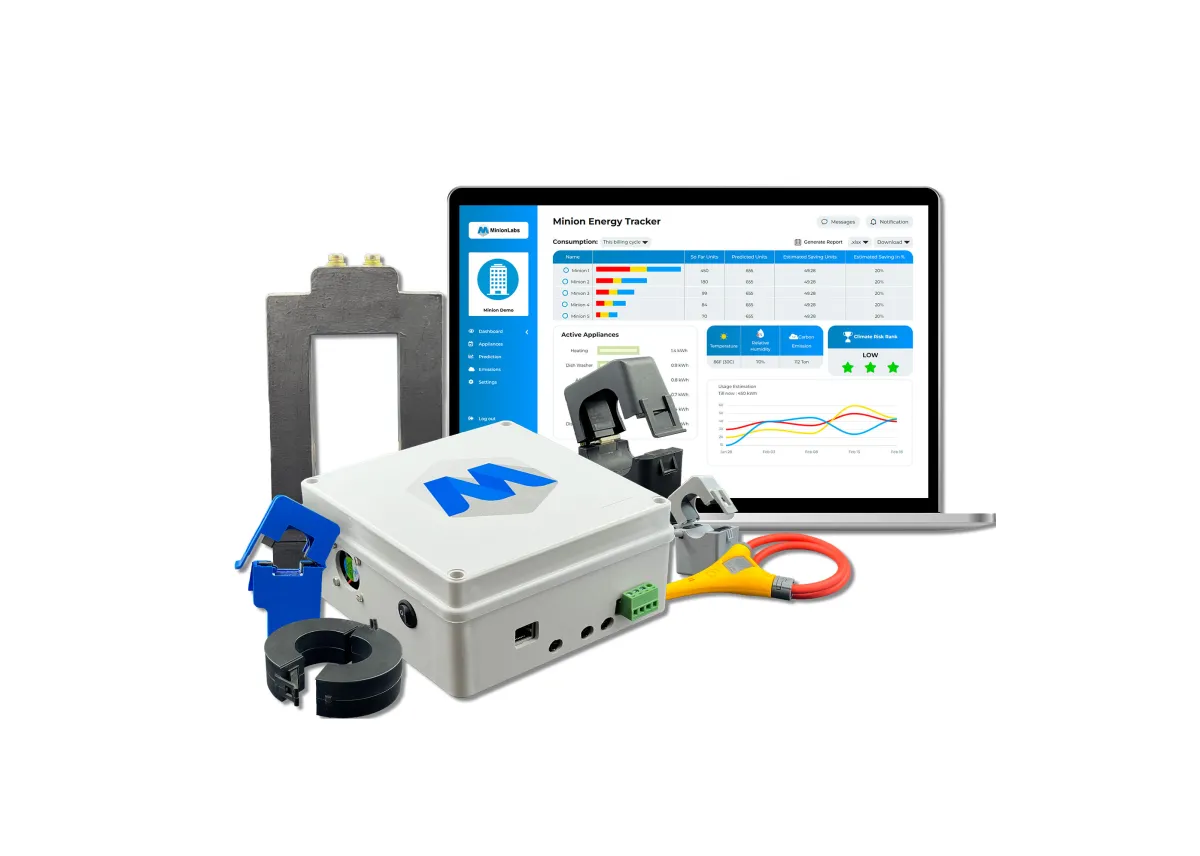
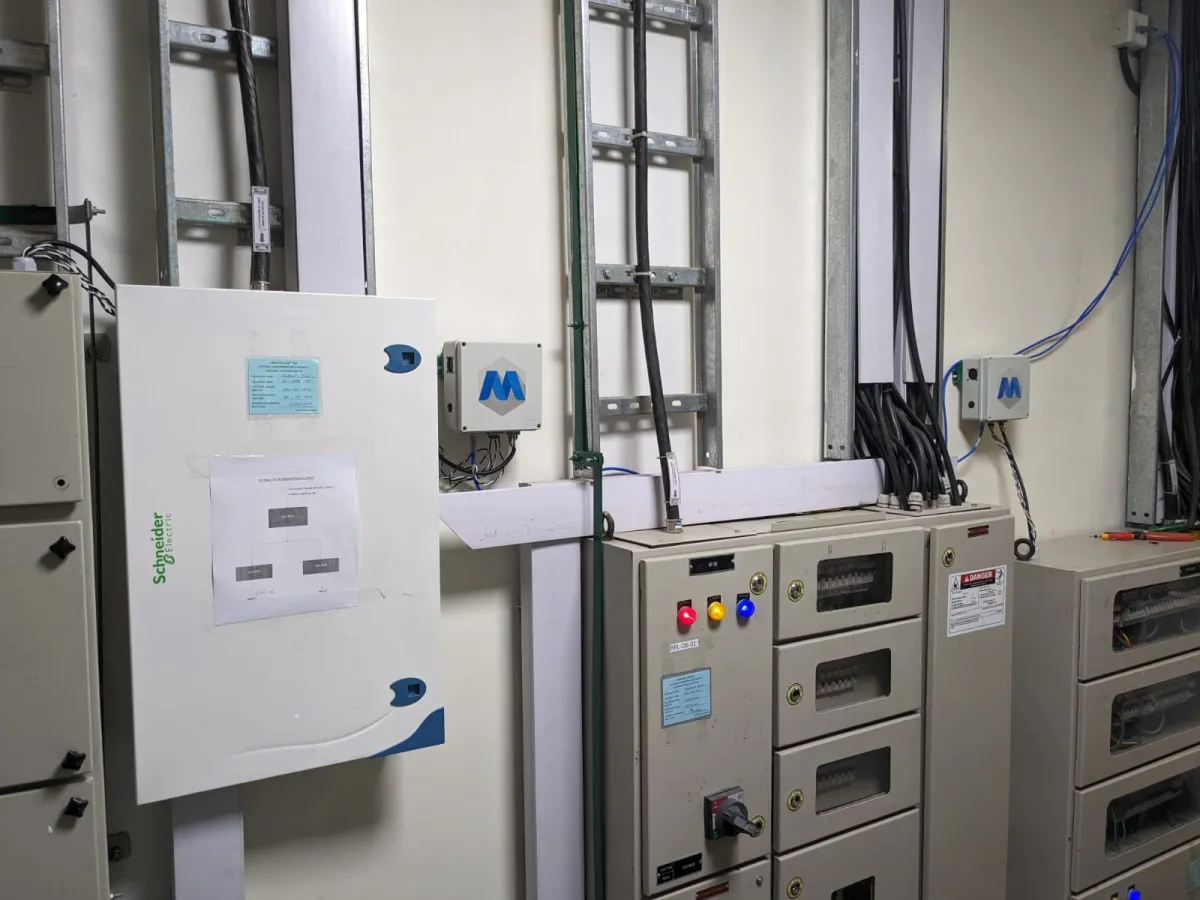
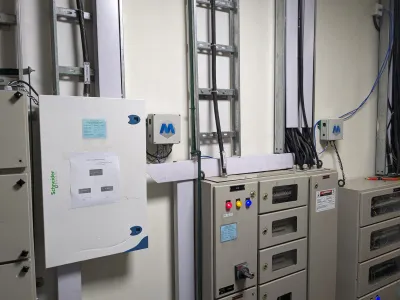
A single smart device that, when clipped onto the main electrical panel of any building, identifies and monitors every individual appliance inside — without requiring a separate sensor on each device. Using a self-learning artificial intelligence engine, the system analyses the unique electrical "signature" each appliance leaves on the power line when it switches on or off, attributes consumption to each asset in real time, and delivers actionable energy-saving recommendations through a web dashboard, SMS, and email. The result is appliance-level energy visibility from one installation point, at a fraction of the cost of conventional sub-metering.
Commercial and industrial buildings consume enormous amounts of electricity, but the tools available to monitor and manage that consumption are fundamentally inadequate. A traditional electricity meter tells a building owner only the total units consumed — nothing about which machine, equipment, or system is responsible for the bill. Existing solutions to this problem — such as smart meters or sub-metering — either provide only marginally better aggregate data (smart meters) or require an expensive, invasive sensor installation on every single electrical circuit or appliance in the building (sub-metering). For a typical industrial facility with 400–500 pieces of equipment across multiple distribution panels, sub-metering requires hundreds of individual sensors, extensive wiring work, significant capital expenditure, and ongoing maintenance — making meaningful energy management economically unviable for most commercial and industrial users.
The invention is a device and method that achieves individual appliance-level energy monitoring from a single measurement point — the building's main electrical panel — without any sensors on individual appliances. The device captures the combined electrical waveform of the entire building at 4 million samples per second. Because every electrical appliance has a unique power consumption signature — a distinctive pattern of voltage, current, harmonics, and switching behaviour when it turns on or off — the device's embedded machine learning engine can identify each appliance and attribute its consumption to it in real time. The ML model is self-learning: it trains on historical data from the specific building it is deployed in, continuously improving its identification accuracy over time and recognising new appliances as they are introduced. The system also predicts future consumption, detects equipment degradation before it causes failure, and generates prioritised recommendations for energy saving — all from a single installation requiring approximately five minutes with no disruption to building operations.
Yes. Prior art in Non-Intrusive Load Monitoring (NILM) existed primarily in the residential sector, where a small number of low-power appliances with repetitive and well-defined signatures made single-point disaggregation feasible. No prior art had successfully commercialised NILM for commercial and industrial buildings — environments characterised by hundreds or thousands of diverse, high-power assets operating simultaneously, with complex overlapping electrical signatures including industrial motors, compressors, HVAC chillers, and variable-frequency drives. The prior art gap was the absence of an ML model capable of reliably disaggregating aggregate waveforms in this level of electrical complexity. Existing commercial solutions either addressed only residential loads, required per-circuit physical sensors (abandoning the non-intrusive principle entirely), or provided only aggregate demand data without asset-level attribution. This invention is the first commercially deployed and patent-protected solution that closes this gap: a self-learning ML engine validated at India's largest industrial and pharmaceutical enterprises — including Maruti Suzuki India Limited and Biocon Limited — achieving 98.24% appliance identification accuracy in complex commercial and industrial environments from a single measurement point.
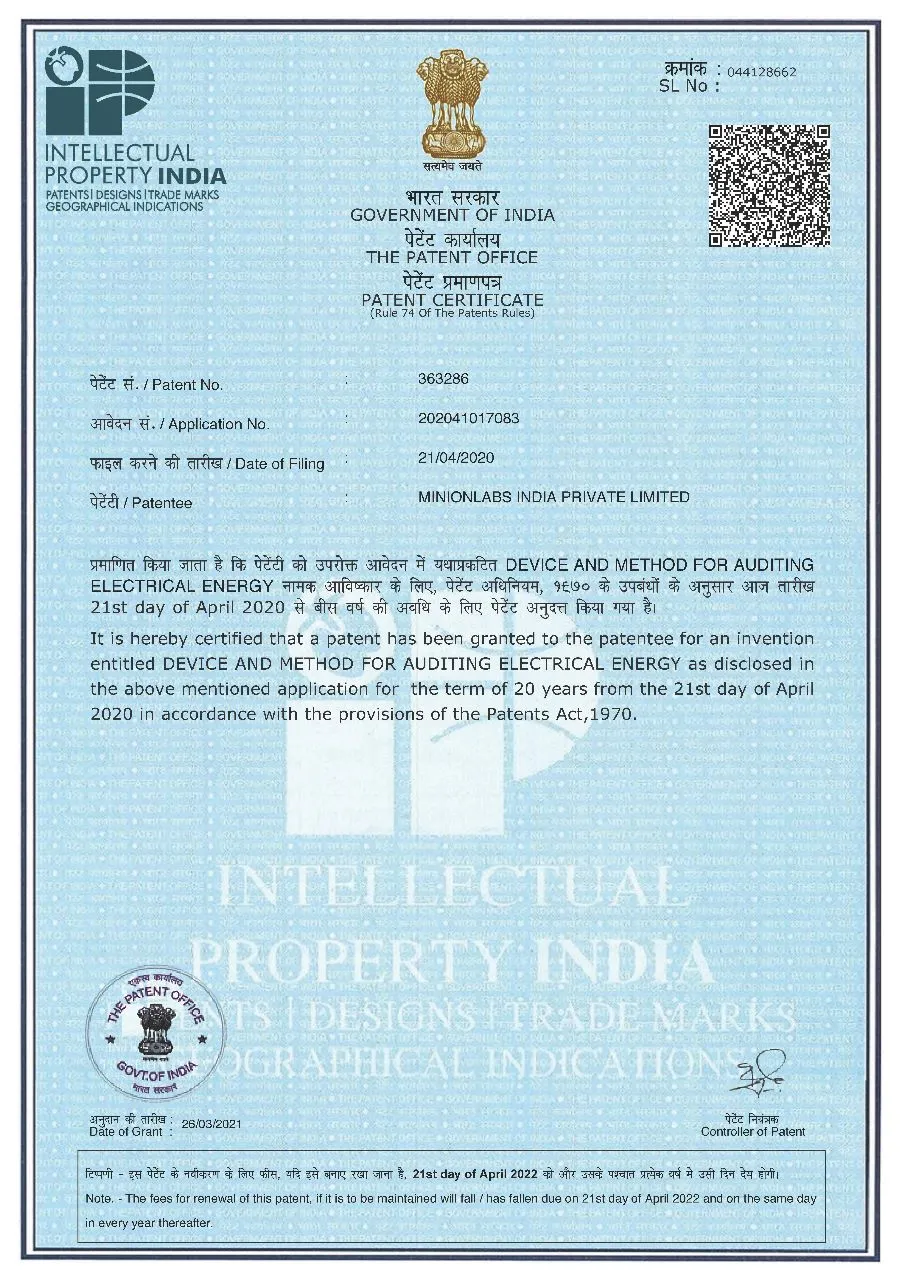
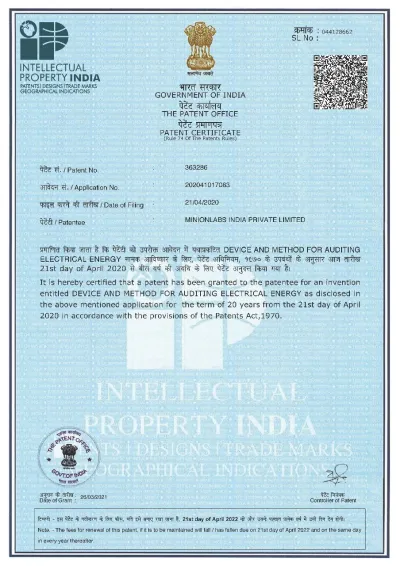
India's first and only commercially deployed AI-powered Non-Intrusive Load Monitoring (NILM) system, backed by a granted Indian patent valid until April 2040.
Unlike traditional energy monitoring — which requires separate sub-meters wired to each circuit or appliance — this invention identifies and measures the energy consumption of individual electrical appliances from a single measurement point at the main electrical panel. No additional wiring, no per-appliance sensors, no civil work.
Key differentiators:
1. Single-device, appliance-level intelligence. One device installed at the distribution board disaggregates the entire electrical load into individual appliance signatures — air conditioners, motors, compressors, lighting, UPS, chillers — in real time. Traditional sub-metering systems require 10–30 separate meters and extensive wiring to achieve the same result.
2. Patented AI engine with 98.24% accuracy. The core machine learning model is trained on millions of data points captured from real commercial and industrial facilities across India. It recognises 8,000+ appliance signatures and predicts energy consumption every second. No competing system in India holds this IP.
3. Commercially validated at India's most demanding enterprises. The technology has been independently deployed and validated at Biocon (32% electricity bill reduction, INR 41.85 Lakh annual savings), Maruti Suzuki India, Carrier Technologies, Nanda Feeds, and Fortis Hospital — across pharmaceutical manufacturing, automotive, agri-industrial, HVAC, and healthcare environments.
4. Up to 45% energy savings demonstrated. Deployments show 20–30% savings in commercial buildings and up to 45% in industrial facilities — with payback periods as short as 2 months at some sites.
5. Non-intrusive installation — 90% lower infrastructure cost. Installation requires no rewiring or electrical downtime. The device clamps onto the existing main incomer at the electrical panel and begins monitoring immediately. Total installed cost is 80–90% lower than an equivalent sub-metering deployment.
6. Full-stack IP included. The patent covers the core device and method. The sale also includes the trained ML model, production-grade source code (cloud + edge + web application), hardware design files and datasets with documentation.
7. PCT application filed internationally. PCT/IB2020/055564 filed, opening pathways for international patent protection in key markets.
Industries where the invention can be useful?
The technology is applicable to any facility with significant electrical loads and a need to reduce energy costs or meet sustainability mandates: Pharmaceutical & Life Sciences — Validated at Biocon; critical for energy-intensive cleanroom, HVAC, and cold storage monitoring under ESG and GMP compliance requirements. Automotive & Heavy Manufacturing — Validated at Maruti Suzuki; applicable to assembly lines, CNC machinery, compressors, and paint shop HVAC systems. Commercial Real Estate & Office Buildings — Validated at Carrier Technologies; suitable for large IT parks, SEZs, office complexes, and co-working spaces. Agri-Industrial & Food Processing — Validated at Nanda Feeds; applicable to poultry farms, feed mills, cold chains, and food processing plants. Hospitals & Healthcare — Validated at Fortis Hospital (INR 18 Lakhs saved in one deployment); critical care HVAC, medical equipment monitoring. Hospitality (Hotels & Resorts) — HVAC, kitchen, and amenity-level monitoring without intrusive metering infrastructure. Educational Institutions & Campuses — Deployed at Greenwood High School; scalable across large multi-building campuses. Data Centres & IT Infrastructure — Server room, UPS, and precision cooling monitoring with appliance-level granularity. Retail Chains & Shopping Malls — Refrigeration, HVAC, and lighting analytics across distributed store networks. Utilities & DISCOMs — Demand-side management, AMI 2.0 smart meter augmentation, non-technical loss detection. Smart Cities & Government Buildings — Municipal facility monitoring, public building energy mandates (BEE Star Labelling, PAT Scheme). Telecom Tower Infrastructure — Diesel generator and AC unit-level monitoring at remote towers. Cold Storage & Warehousing — Refrigeration compressor and condenser unit-level energy tracking.An estimate of the total addressable market?
India (Primary, Patent-Protected Market) India represents a fully patent-protected, high-growth market where no competitor can deploy NILM commercially without licensing or acquiring this patent. India's commercial and industrial electricity consumption exceeds 700 billion kWh annually. At a conservative 10% addressable penetration and average system revenue of ₹1.5 Lakh per installation, the India TAM for NILM-based energy management exceeds ₹10,000 Crore (≈ USD 1.2 Billion) across manufacturing, commercial real estate, and institutional buildings. India's Building Energy Management System (BMS) market is projected to grow from USD 800 Million (2024) to USD 2.4 Billion by 2030 (CAGR ~20%), driven by BEE mandates, ESG reporting requirements, and the national PAT (Perform, Achieve, Trade) scheme covering 1,000+ large energy consumers. India's AMISP smart metering rollout (250 million smart meters mandated by 2026) creates a direct embedded-NILM opportunity, as utilities are mandated to provide consumption analytics to large commercial consumers. The energy audit services market in India (BEE-accredited) is valued at USD 350 Million and growing at 15% annually — NILM is the core enabling technology for tech-augmented audits. Global (PCT Pathway Available) The global NILM / energy disaggregation market is valued at USD 5.3 Billion (2024) and projected to reach USD 14.7 Billion by 2030 at a CAGR of 18.5% (MarketsandMarkets). Global smart meter market (key embedded-NILM channel): USD 23 Billion in 2024, growing to USD 42 Billion by 2029. The global industrial energy management market stands at USD 42 Billion (2024), with AI-based sub-metering and disaggregation being the fastest-growing segment.Potential Customers/End Users. Who might benefit?
Who buys the patent (IP acquirer): Global NILM and energy disaggregation companies seeking India market entry (the patent blocks their India commercialisation) Building automation and energy management companies (Honeywell, Siemens, Schneider Electric, ABB, Johnson Controls) seeking to embed appliance-level intelligence into their existing India platforms Smart meter OEMs (Itron, Landis+Gyr) embedding NILM into next-generation AMI 2.0 meters for Indian utilities Indian energy services companies (ESCOs) and audit firms seeking a tech-augmented audit product C&I solar developers seeking load-side visibility to complement solar generation monitoring Who pays to use the technology (end customers for the acquirer): Facility managers and building owners at commercial buildings, factories, hospitals, hotels, and campuses Energy managers at large industrial enterprises mandated under India's PAT Scheme (Bureau of Energy Efficiency) DISCOMs and state electricity utilities using NILM for consumer-side demand-side management Real estate developers building green-certified (IGBC/LEED/GRIHA) commercial properties ESG and sustainability officers at listed Indian companies (SEBI BRSR reporting mandates) Carbon credit project developers requiring Measurement, Reporting, and Verification (MRV) of energy savingsDocuments
-
1781284810325_414.pdf
Actions
Added all portfolio
| Country | Current Status | Patent Application Number | Patent Number | Applicant / Current Assignee Name | Title | Google Patent Link |
| India | Granted | 202041017083 | 363286 | MinionLabs India Private Limited | DEVICE AND METHOD FOR AUDITING ELECTRICAL ENERGY | Google patent link |
You may also like the following patent