



















Composite Impact-Absorbing Road Divider

This invention relates to a lightweight composite road divider designed to improve road safety. The divider is made from a reinforced polymer hollow structure filled with cushioning materials such as foam, rubber, thermocol, or nanofibers, which help absorb impact during vehicle collisions.
Unlike traditional concrete dividers, this design is lighter, easier to transport and install, and capable of reducing the force transferred to vehicles during accidents. The divider is manufactured using a composite molding process (Vacuum Assisted Resin Transfer Molding – VARTM) that provides high strength, durability, and improved structural performance.
Overall, the invention aims to reduce injuries, improve road safety, and provide a more durable and efficient alternative to conventional concrete road dividers.
Problem the Invention Addresses (Simplified Explanation)
Road accidents are a major global safety concern, particularly on highways and high-speed roads. One of the key contributors to severe injuries in accidents is the rigid structure of traditional road dividers, which are typically made from heavy concrete. When a vehicle collides with these structures, the divider does not absorb the impact energy. Instead, the force is transferred directly back to the vehicle and its passengers, often causing serious injuries, vehicle damage, or fatalities.
In many cases, road dividers are designed primarily to separate traffic lanes rather than to manage collision impacts. Because they are solid and non-flexible, they can create a strong reverse impact force during accidents. Studies and safety reports indicate that a noticeable percentage of road fatalities occur due to collisions with rigid roadside structures such as concrete barriers.
Another challenge with conventional dividers is their weight and handling difficulty. Concrete barriers are extremely heavy, which makes transportation, installation, and relocation complex and expensive. Large machinery and significant labor are usually required to install or move them. This limits flexibility in road design and makes temporary or modular traffic management difficult.
Traditional dividers can also face maintenance and durability issues over time. Cracks, weather exposure, and repeated impacts can reduce their effectiveness, requiring repair or replacement. In addition, concrete dividers generally provide limited adaptability in terms of design or material performance, making it difficult to optimize them for safety improvements or modern infrastructure requirements.
Overall, the main problem addressed by the invention is the lack of road dividers that combine structural strength with impact-absorbing capability, lightweight construction, and easier handling. There is a need for a safer alternative that can reduce the severity of collisions while still effectively separating traffic lanes and maintaining durability on highways and urban roads.
The invention aims to solve these challenges by introducing a road divider structure that can absorb impact energy, reduce reverse collision forces, and offer improved strength while remaining lighter and easier to handle than traditional concrete dividers.
The Invention – Solution to the Problem
The invention provides a composite road divider designed to improve road safety by reducing the impact force during vehicle collisions while maintaining structural strength and durability. Instead of using traditional solid concrete barriers, the invention introduces a lightweight divider made from reinforced polymer composite materials with an internal cushioning structure.
The road divider consists of a molded reinforced polymeric hollow body that defines an internal void. This hollow cavity is partially filled with compressible cushioning materials such as foam, rubber, thermocol, or nylon nanofibers, which act as an energy-absorbing layer. When a vehicle collides with the divider, these materials help absorb and dissipate the impact energy, reducing the force that is transferred back to the vehicle and its passengers.
The outer structure of the divider is made from reinforced polymer composites, which provide high strength, durability, and resistance to environmental conditions. Reinforcement fibers such as glass fibers and woven fibers are used within the polymer matrix to increase tensile and flexural strength, allowing the divider to withstand road conditions and repeated stresses.
The divider is designed with supporting feet members extending from the base, enabling the structure to stand independently on the road surface. The walls of the divider extend upward from these base members and meet at the top, forming a stable structure capable of separating traffic lanes effectively while maintaining mechanical strength.
Another important aspect of the invention is the manufacturing method. The hollow composite body is produced using a Vacuum Assisted Resin Transfer Molding (VARTM) process, a technique commonly used in advanced composite manufacturing. This process ensures proper infusion of resin through reinforcement fibers, resulting in a strong and uniform composite structure.
By combining composite materials, internal cushioning, and an efficient manufacturing method, the invention offers several practical advantages over traditional concrete road dividers. The divider is lighter, easier to transport and install, more durable, and capable of reducing injury risks during collisions. At the same time, it maintains the primary function of separating traffic lanes and improving overall road safety.
Overall, the invention presents a safer and more efficient alternative to conventional road dividers, addressing both safety concerns and operational challenges in modern road infrastructure.
Yes, the invention addresses a significant gap in prior road divider technologies.
Gap in Prior Art
Traditional road dividers are primarily made from solid concrete or other rigid materials. While these structures effectively separate traffic lanes, they are not designed to manage collision impacts safely. When a vehicle hits a rigid divider, the structure does not absorb the impact energy. Instead, it reflects a strong reverse force back to the vehicle, which can lead to severe passenger injuries, vehicle damage, and sometimes fatalities.
Another limitation in prior designs is the lack of lightweight and modular structures. Concrete barriers are extremely heavy, making transportation, installation, and relocation difficult and costly. This creates operational challenges for highway authorities, especially when road infrastructure requires temporary installations, redesign, or maintenance work.
Existing barriers also typically lack energy-absorbing internal structures. Most prior road dividers focus on structural strength rather than impact mitigation. As a result, they do not effectively reduce the force generated during collisions, which is a critical factor in improving road safety.
How the Invention Fills This Gap
The patented invention introduces a composite road divider with a hollow reinforced polymer structure filled with cushioning materials. This design provides a balance between strength and impact absorption. The internal cushioning materials help dissipate collision energy, reducing the reverse impact force transmitted to vehicles and passengers.
In addition, the use of composite materials and advanced manufacturing processes such as Vacuum Assisted Resin Transfer Molding (VARTM) enables the divider to be significantly lighter while maintaining high structural strength. This improves ease of handling, installation, and long-term durability.
Summary of the Gap Addressed
- Lack of impact-absorbing road divider structures
- Overreliance on rigid and heavy concrete barriers
- Limited focus on passenger safety during collisions
- Difficult transportation and installation due to high weight
By addressing these limitations, the invention provides a safer, lighter, and more efficient road divider solution that improves both infrastructure performance and road safety outcomes.
Unique Features of the Invention
- Composite Hollow Structure: The road divider is built using a reinforced polymer composite hollow body instead of traditional solid concrete, making it lighter while maintaining strength.
- Impact-Absorbing Cushioning Core: The internal cavity of the divider is partially filled with compressible cushioning materials such as foam, rubber, thermocol, or nylon nanofibers that help absorb collision energy.
- Enhanced Structural Strength: The polymer matrix is reinforced with fibers such as glass fibers and woven fibers to increase tensile and flexural strength.
- Lightweight and Easy Handling: Compared to traditional concrete barriers, the composite construction significantly reduces weight, allowing easier transportation, installation, and maintenance.
- Energy Dissipation During Collision: The design helps reduce reverse impact force transmitted to vehicles and passengers during accidents, improving road safety.
- Advanced Manufacturing Process: The divider is manufactured using Vacuum Assisted Resin Transfer Molding (VARTM), which ensures uniform composite formation and improved durability.
- Self-Standing Structural Design: The divider includes extended base feet and opposing walls joined at the apex, providing stability while maintaining structural efficiency.
Industries where the invention can be useful?
This invention has strong commercial potential in sectors related to road safety, transportation infrastructure, and urban development. Governments and private infrastructure developers continuously invest in improving road safety and highway infrastructure, creating demand for safer and more efficient road barrier solutions. A lightweight, impact-absorbing road divider can help reduce accident severity, simplify installation, and lower transportation and maintenance costs, making it attractive for large-scale infrastructure projects. Industries / Sectors Where the Invention Can Be Useful Highway and Road Infrastructure Development Government Road Authorities and Public Works Departments (PWD) National Highway and Expressway Projects Urban Infrastructure and Smart City Development Transportation Safety Equipment Manufacturing Construction and Civil Engineering Companies Infrastructure EPC Contractors Industrial and Private Road Network Development (ports, SEZs, industrial parks) Airport and Large Facility Traffic Management Systems These sectors regularly require traffic separation systems, safety barriers, and road infrastructure components, making them ideal commercial markets for this invention.An estimate of the total addressable market?
Market Size (Estimated Total Addressable Market) The invention targets the global road infrastructure and road safety equipment market, which includes products such as road dividers, crash barriers, guardrails, and traffic safety systems. The global road infrastructure market is estimated to be over USD 1 trillion annually, driven by ongoing highway construction and urban road development. The road safety and traffic barrier systems market is estimated to be around USD 5–10 billion globally, with steady growth due to increasing focus on reducing road accidents. In India, large national programs such as highway expansion and expressway development create a multi-billion-dollar market opportunity for road safety infrastructure, including dividers and crash barriers. Estimated Total Addressable Market: Approximately USD 5–10+ billion globally in the road safety barrier and divider segment, with strong growth expected due to increasing investments in transportation infrastructure and road safety improvements.Potential Customers/End Users. Who might benefit?
The invention can benefit organizations involved in road construction, highway development, and traffic safety infrastructure, particularly those responsible for installing and maintaining road dividers and safety barriers. Key Potential Customers and End Users • Government Road Authorities – National highway agencies, ministries of transport, and public works departments responsible for road safety and infrastructure development. • Highway and Expressway Developers – Organizations involved in building and operating national highways, expressways, and toll road projects. • Infrastructure EPC Contractors – Companies that construct roads, bridges, and large transportation projects. • Urban Development Authorities – Municipal corporations and smart city authorities responsible for urban road planning and traffic management. • Construction and Civil Engineering Firms – Companies involved in road construction, infrastructure maintenance, and large-scale civil engineering projects. • Industrial Infrastructure Developers – Operators of industrial parks, ports, logistics hubs, and large facilities that require internal road safety systems. • Airport Authorities and Transport Hubs – Airports and large transport facilities where internal road traffic needs separation and safety barriers. These stakeholders frequently require durable, safe, and cost-effective road divider systems, making them the primary end users or buyers for this invention.Actions
Added all portfolio
| Country | Current Status | Patent Application Number | Patent Number | Applicant / Current Assignee Name | Title | Google Patent Link |
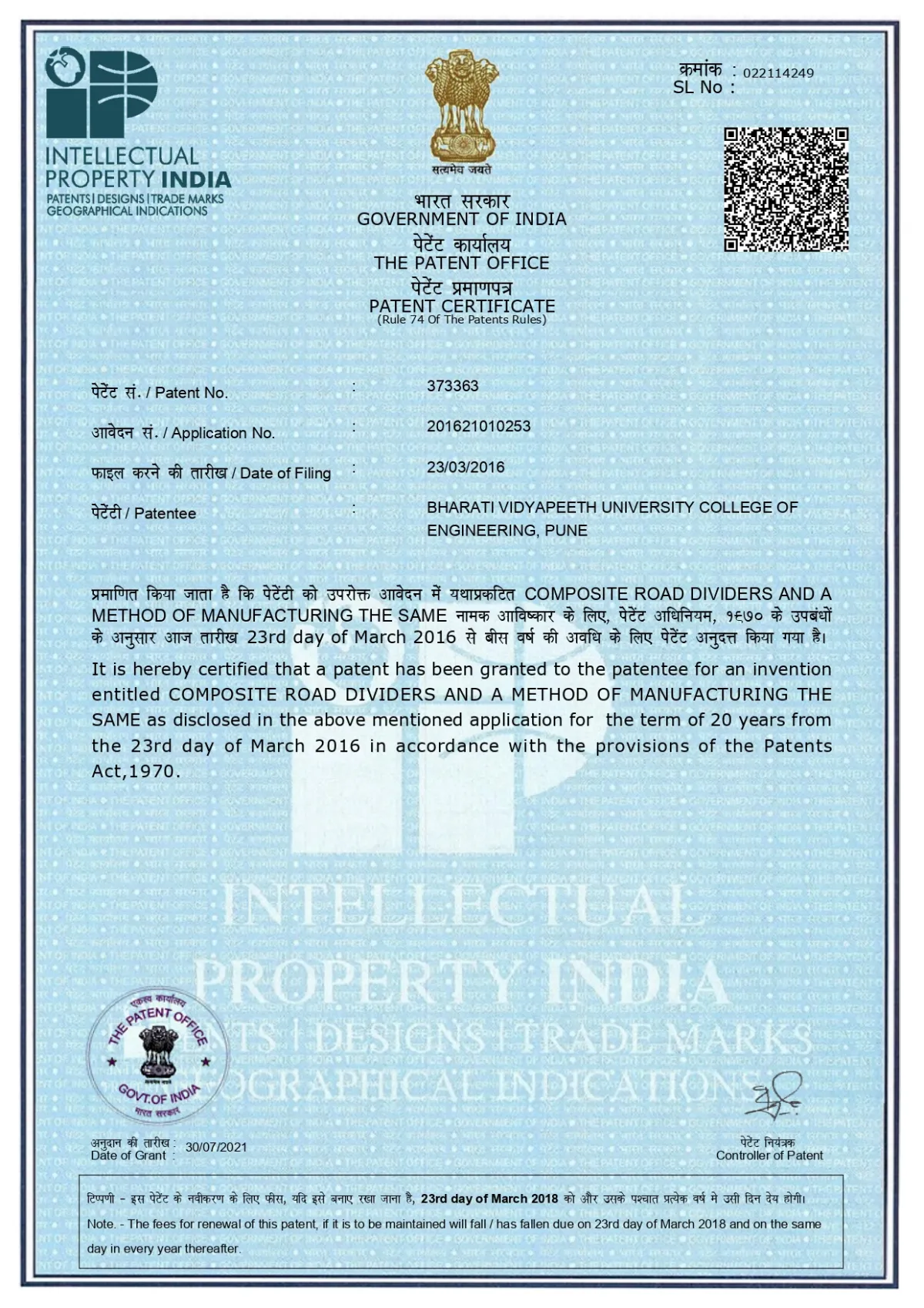
| India | Granted | 201621010253 | 373363 | Bharati Vidyapeeth University College of Engineering, Pune | Composite Road Dividers and a Method of Manufacturing the Same | Google patent link |
You may also like the following patent
Seat 3D in car
| Available For: France | Automotive and Transportation |
Cinema 3D in car, Virtual reality therapy, Phobia treatment, Relaxation, Entertainment and Revolutionary Immersive Experience.
| Application Number | FR1871076 |
| Patent Number | FR3086223 |
| Current Status | Granted |
Full Face Collapsible Motorcycle Helmet
| Available For: India | Automotive and Transportation |
The invention is an innovative collapsible motorcycle helmet that addresses one of the biggest challenges faced by riders—the inconvenience of carrying and storing conventional helmets. Unlike...
| Application Number | 202021024902 |
| Patent Number | 407368 |
| Current Status | Granted Patent |
patent titled " collision impact reducer"
| Available For: United States | Automotive and Transportation |
It is a device to reduce the impact of collision in automobiles. The same can be used in crash barriers, pillars of bridges and railway lines, culverts of bridges, beginning points of road medians,...
| Application Number | 16616449 |
| Patent Number | US 12018727 B2 |
| Current Status | Granted |
New Crank Arm Mechanism
| Available For: India | Automotive and Transportation |
The Invention: This invention (Patent No. 436717) is a new type of pedal arm for bicycles. Instead of two normal straight arms, one of the sides uses a curved, semi-circular arm made of a lighter...
| Application Number | 201611007871 |
| Patent Number | 436717 |
| Current Status | Granted |