



















Automated System for Pharmaceutical Formulation Optimization
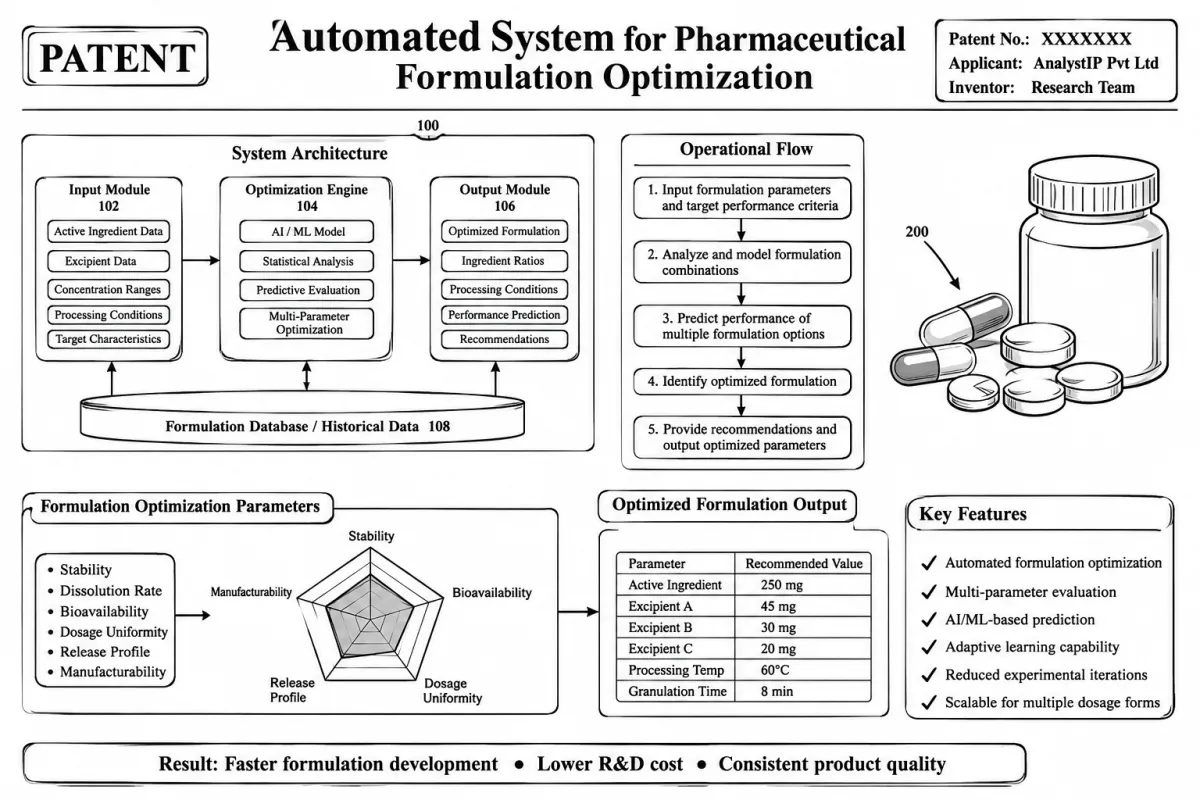
The present invention relates to an automated system for optimizing pharmaceutical formulations through systematic analysis and intelligent evaluation of formulation parameters. The system receives input data associated with active pharmaceutical ingredients, excipients, concentration ranges, processing conditions, and desired formulation characteristics. A computational optimization module analyzes the input data to identify suitable combinations of formulation components and processing parameters based on predefined performance criteria, including stability, dissolution rate, bioavailability, manufacturability, and dosage uniformity. The system may employ machine learning, statistical modeling, or optimization algorithms to evaluate multiple formulation combinations and predict their performance. Based on the analysis, the system generates an optimized formulation and provides recommendations regarding ingredient proportions and processing conditions. The automated approach reduces dependence on repetitive laboratory experimentation, minimizes development time and material consumption, and facilitates consistent formulation development. The system may be adapted for tablets, capsules, liquid formulations, injectable preparations, and other pharmaceutical dosage forms.
Pharmaceutical formulation development traditionally requires extensive laboratory experimentation to determine the appropriate combination and concentration of active pharmaceutical ingredients, excipients, and processing parameters. This trial-and-error approach can be time-consuming, costly, and resource-intensive. Small changes in formulation parameters may significantly affect critical attributes such as stability, dissolution, bioavailability, dosage uniformity, and manufacturability.
Existing formulation development processes also rely heavily on manual data analysis and the experience of formulation scientists, making it difficult to efficiently evaluate a large number of possible formulation combinations. Inadequate optimization may result in repeated experiments, increased development costs, inconsistent formulation performance, and delays in bringing pharmaceutical products to market.
The present invention provides an automated system for pharmaceutical formulation optimization that systematically analyzes formulation variables and identifies an optimized combination of pharmaceutical ingredients and processing parameters.
The system receives formulation-related inputs, including active pharmaceutical ingredients, excipients, concentrations, processing conditions, and target product characteristics. An optimization engine processes these parameters using statistical models, machine-learning algorithms, or other computational techniques to evaluate multiple possible formulation combinations.
Based on predefined performance criteria such as stability, dissolution, bioavailability, hhhdosage uniformity, release profile, and manufacturability, the system identifies the most suitable formulation parameters and generates optimization recommendations.
Yes, a major gap exists.
Despite existing pharmaceutical formulation software, statistical optimization tools, and computer-aided drug development systems, there remains a gap in fully automated, end-to-end formulation optimization. Many existing approaches require significant manual intervention by formulation scientists to select variables, define experimental combinations, interpret results, and determine the final formulation.
The proposed invention addresses this gap by integrating formulation data acquisition, parameter evaluation, predictive analysis, optimization, and formulation recommendation within a unified automated system. This enables the system to evaluate multiple formulation variables simultaneously and identify optimized combinations based on predefined pharmaceutical performance criteria.
- Automated Formulation Optimization – Automatically evaluates formulation variables and identifies suitable ingredient combinations without relying entirely on manual trial-and-error methods.
- Multi-Parameter Optimization – Simultaneously considers factors such as stability, dissolution, bioavailability, dosage uniformity, release profile, and manufacturability.
- AI/ML-Based Prediction – Uses machine-learning or predictive algorithms to assess the expected performance of different formulation combinations.
- Adaptive Learning Capability – Incorporates historical formulation and experimental data to continuously improve subsequent optimization recommendations.
- Automated Parameter Recommendation – Generates recommended concentrations, ingredient ratios, and processing conditions based on predefined target characteristics.
- Reduced Experimental Iterations – Helps minimize unnecessary laboratory trials, material consumption, development time, and formulation development costs.
Industries where the invention can be useful?
Pharmaceutical Industry Biopharmaceutical Industry Generic Drug Manufacturing Branded Drug Manufacturing Drug Discovery & Development Contract Development and Manufacturing Organizations (CDMOs) Contract Research Organizations (CROs)An estimate of the total addressable market?
USD 616.2 billionPotential Customers/End Users. Who might benefit?
Pharmaceutical Companies – For developing and optimizing new and existing drug formulations. Generic Drug Manufacturers – For optimizing formulations during generic product development. Biopharmaceutical Companies – For complex formulations involving biologics and advanced therapies. CDMOs – To provide faster and more data-driven formulation development services to pharmaceutical clients. CROs – For formulation research, experimental design, and optimization services. Drug Discovery & Development Companies – To optimize drug products before clinical development. Specialty Pharmaceutical Companies – For complex and niche dosage forms. API & Pharmaceutical Ingredient Manufacturers – To evaluate how APIs and excipients affect final formulations. Nutraceutical Companies – For optimization of supplement and nutraceutical formulations. Veterinary Pharmaceutical Companies – For development of animal drug formulations. Drug Delivery Technology Companies – For optimizing controlled-release, targeted, nanoparticle, and other delivery systems.Actions
Added all portfolio
| Country | Current Status | Patent Application Number | Patent Number | Applicant / Current Assignee Name | Title | Google Patent Link |
| India | Grant | 234567 | 43176 | test08 | Automated System for Pharmaceutical Formulation Optimization | Not mentioned |
You may also like the following patent